
What is a balanced investment approach?
TL;DR:
- A balanced investment approach combines growth and defensive assets to maximize returns while managing risk. It relies on asset allocation to build wealth and protect against market downturns throughout different life stages.
A balanced investment approach is defined as a portfolio strategy that combines growth assets, such as equities and property, with defensive assets, such as bonds and cash, to pursue steady returns while managing risk. The industry standard term for this practice is asset allocation, and it sits at the core of every well-constructed portfolio. Balanced portfolios serve two purposes: building wealth over time and protecting against sharp market downturns. Australian superannuation funds commonly use 60/40, 50/50, and 70/30 splits between growth and defensive assets, giving investors a practical benchmark to measure their own mix. Understanding what is a balanced investment approach, and why it matters, is the first step toward building a portfolio that works across different market conditions.
What is a balanced investment approach and how does it work?
A balanced investment approach works by spreading capital across asset classes that behave differently under various economic conditions. When equities fall, defensive assets like government bonds and cash typically hold their value, smoothing out the overall portfolio return. A typical balanced portfolio in Australia holds approximately 50% to 70% growth assets and 30% to 50% defensive assets, depending on the investor’s age, goals, and risk tolerance. This range reflects the standards used by large superannuation funds, including Australian Retirement Trust, and gives individual investors a credible starting point.

The key insight is that growth and protection are not competing goals. They are complementary, and the right mix depends on your life obligations, income needs, and investment horizon. A 35-year-old building wealth has a very different risk capacity than a 60-year-old approaching retirement, and their portfolios should reflect that difference clearly.
Growth assets vs defensive assets
Growth assets include Australian and international shares, listed property trusts, and direct real estate. They carry higher short-term volatility but deliver stronger long-term capital gains. Defensive assets include government and corporate bonds, term deposits, and cash. They generate income and preserve capital during downturns, but they grow slowly over time.
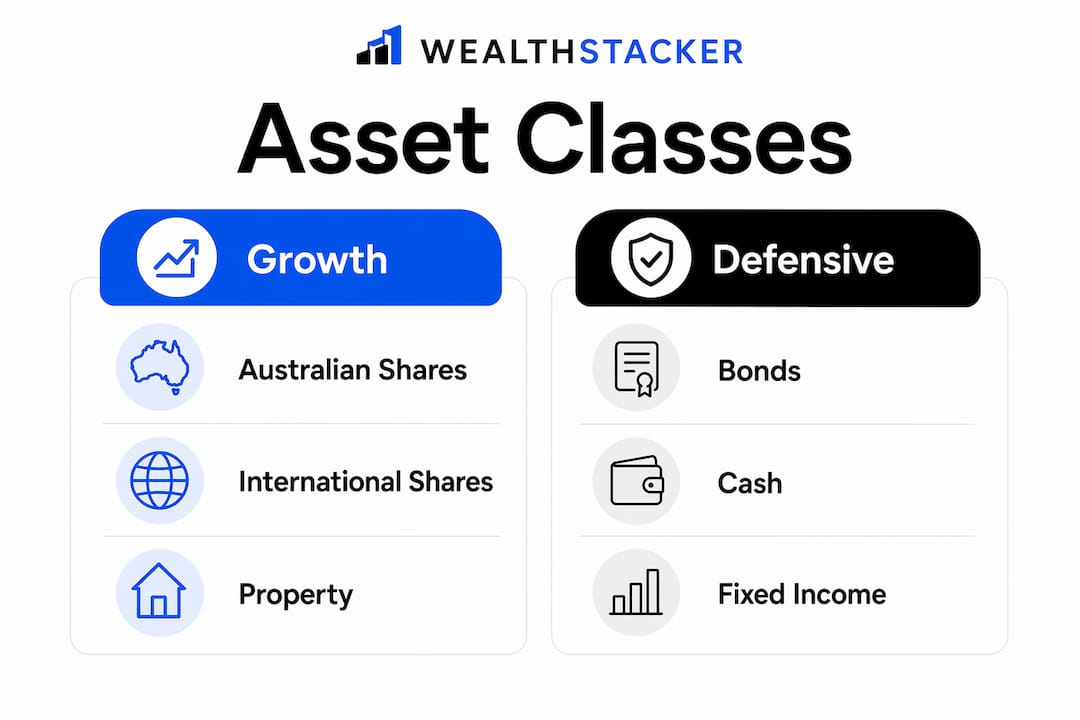
The distinction matters because each asset class responds differently to interest rate changes, inflation, and economic cycles. A portfolio holding only shares can lose a significant portion of its value in a single year. A portfolio holding only cash will almost certainly lose purchasing power to inflation over a decade.
Common allocation models and the 110 minus age rule
The 110 minus age heuristic gives investors a quick starting point for equity allocation. A 35-year-old would target roughly 75% in growth assets, while a 60-year-old would shift toward a 50/50 split. This rule adjusts for the reality that younger investors have more time to recover from market falls, while older investors need more stability.
| Life stage | Growth assets | Defensive assets | Example split |
|---|---|---|---|
| Early career (25–35) | High | Low | 75/25 |
| Mid-career (40–50) | Moderate-high | Moderate | 65/35 |
| Pre-retirement (55–65) | Moderate | Moderate-high | 50/50 |
| Retirement (65+) | Low-moderate | High | 35/65 |
These splits are guides, not rules. Individual risk tolerance, income sources, and financial goals all require adjustments beyond age alone.
Why asset allocation is the most important investment decision
Asset allocation accounts for up to 94% of portfolio return variability. That figure, cited by NABtrade, means the decision of how you split your money across asset classes matters far more than which specific shares or funds you pick. Most investors spend their energy on stock selection, but the bigger lever is the allocation itself.
Discipline in holding your target allocation through market cycles consistently outperforms attempts at market timing. Selling equities when markets fall and buying back after recovery is one of the most common and costly mistakes individual investors make. The data is clear: returning to your target allocation regularly produces better long-term results than reacting to short-term market noise.
“Discipline and avoiding emotional investment decisions remain key to successful asset allocation and capitalising on long-term compounding benefits. Investors who stick to their target allocation through volatility consistently outperform those who attempt to time the market.” — Approved Financial Planners
Pro Tip: Set a calendar reminder every six months to check your portfolio’s actual allocation against your target. If any asset class has drifted more than 5% from its target weight, rebalance. This removes emotion from the process entirely.
One important nuance: equities and bonds do not always move inversely, particularly during inflationary periods. In some macroeconomic conditions, both asset classes can fall simultaneously. This is why a truly diversified investment portfolio may need to look beyond the traditional 60/40 model and consider assets like infrastructure, listed property, or commodities as additional buffers.
How does a balanced strategy adapt as your life changes?
A balanced investment strategy is not a fixed formula. It shifts as your age, income, family situation, and financial goals evolve. The concept of a glide path describes this gradual shift from growth-heavy to defensive-heavy allocations as an investor approaches retirement. Most lifecycle superannuation products automate this shift, but individual investors managing their own portfolios need to do it deliberately.
The four key moments that typically trigger an allocation review are:
- A major life event. Marriage, divorce, the birth of a child, or a significant inheritance all change your financial obligations and risk capacity. Review your allocation within three months of any major life change.
- A change in income or employment. Losing a stable salary reduces your ability to absorb short-term losses. A higher-income period may allow you to take on more growth exposure.
- Approaching a financial goal. If you plan to buy a property in three years, the funds earmarked for that purchase should shift into lower-risk assets well before you need them.
- Annual review. At a minimum, review your allocation once a year. Markets move, and even a passive portfolio drifts from its target over time.
One risk that many younger investors overlook is the danger of being too conservative too early. A default balanced super fund option may be too conservative for a 28-year-old with a 35-year investment horizon. Sitting in a 50/50 fund when you could sustain a 75/25 growth allocation means leaving significant compounding returns on the table. Inflation alone can erode the real value of an overly defensive portfolio over decades.
Investors building a property portfolio alongside other assets face an additional layer of complexity. Direct property is illiquid, which affects how you count it within your overall allocation. A property worth $600,000 cannot be sold in a week to rebalance a portfolio, so its weighting needs careful consideration alongside liquid assets.
Practical steps to build and maintain a balanced portfolio
Building a balanced portfolio starts with two honest answers: what return do you need, and how much loss can you tolerate without selling? These two questions define your risk profile, and your risk profile determines your target allocation.
The practical steps from there are straightforward:
- Define your goals and time horizon. A 10-year goal for retirement and a 3-year goal for a home deposit require completely different allocations. Separate them clearly.
- Choose diversified funds or ETFs for each asset class. A single broad-market Australian shares ETF and a single bond fund can cover the core of a balanced portfolio at very low cost. You do not need dozens of holdings.
- Keep costs low. Simplified portfolio structures using Australian shares and cash can outperform complex balanced funds when fees and liquidity are factored in. Every 0.5% saved in annual fees compounds significantly over 20 years.
- Set a rebalancing schedule. Quarterly or semi-annual rebalancing works for most investors. Avoid rebalancing after every market move, as transaction costs and tax events add up quickly.
- Avoid overtrading. Frequent buying and selling destroys returns through brokerage fees, capital gains tax events, and the psychological trap of chasing recent performance.
Pro Tip: If you are starting out, a two-fund portfolio covering Australian equities and a diversified bond fund covers the fundamentals of a balanced strategy. Add asset classes only when you understand exactly what role they play in your overall allocation.
Investors who are also renting and building a portfolio while renting face a specific challenge: they lack the equity buffer that property owners use as collateral. For these investors, a higher allocation to liquid growth assets like shares and ETFs makes practical sense, with a clear plan to transition into property when borrowing capacity allows.
Regular monitoring is the final piece. Checking your portfolio too often encourages emotional reactions. Checking it too rarely means you miss significant drift from your target allocation. The right frequency for most investors is monthly for awareness and semi-annual for action. Practical portfolio monitoring tips can help busy investors stay on track without spending hours each week on their finances.
Key takeaways
A balanced investment approach works because asset allocation, not stock selection, drives the vast majority of long-term portfolio returns.
| Point | Details |
|---|---|
| Asset allocation drives returns | Allocation decisions account for up to 94% of portfolio return variability, making it the priority decision. |
| Growth and defensive assets work together | Equities build wealth; bonds and cash protect it. Both roles are necessary in a well-structured portfolio. |
| Allocation must shift over time | Use a glide path to move from growth-heavy to defensive-heavy as retirement approaches or goals change. |
| Discipline beats market timing | Returning to your target allocation regularly outperforms emotional reactions to short-term market moves. |
| Simplicity reduces cost drag | A two or three-fund portfolio often outperforms complex balanced funds once fees and liquidity are considered. |
Wealthstacker makes balanced portfolio tracking straightforward
Knowing your target allocation is one thing. Tracking whether your actual portfolio matches it is another challenge entirely, especially when you hold property, shares, and cash across multiple accounts.
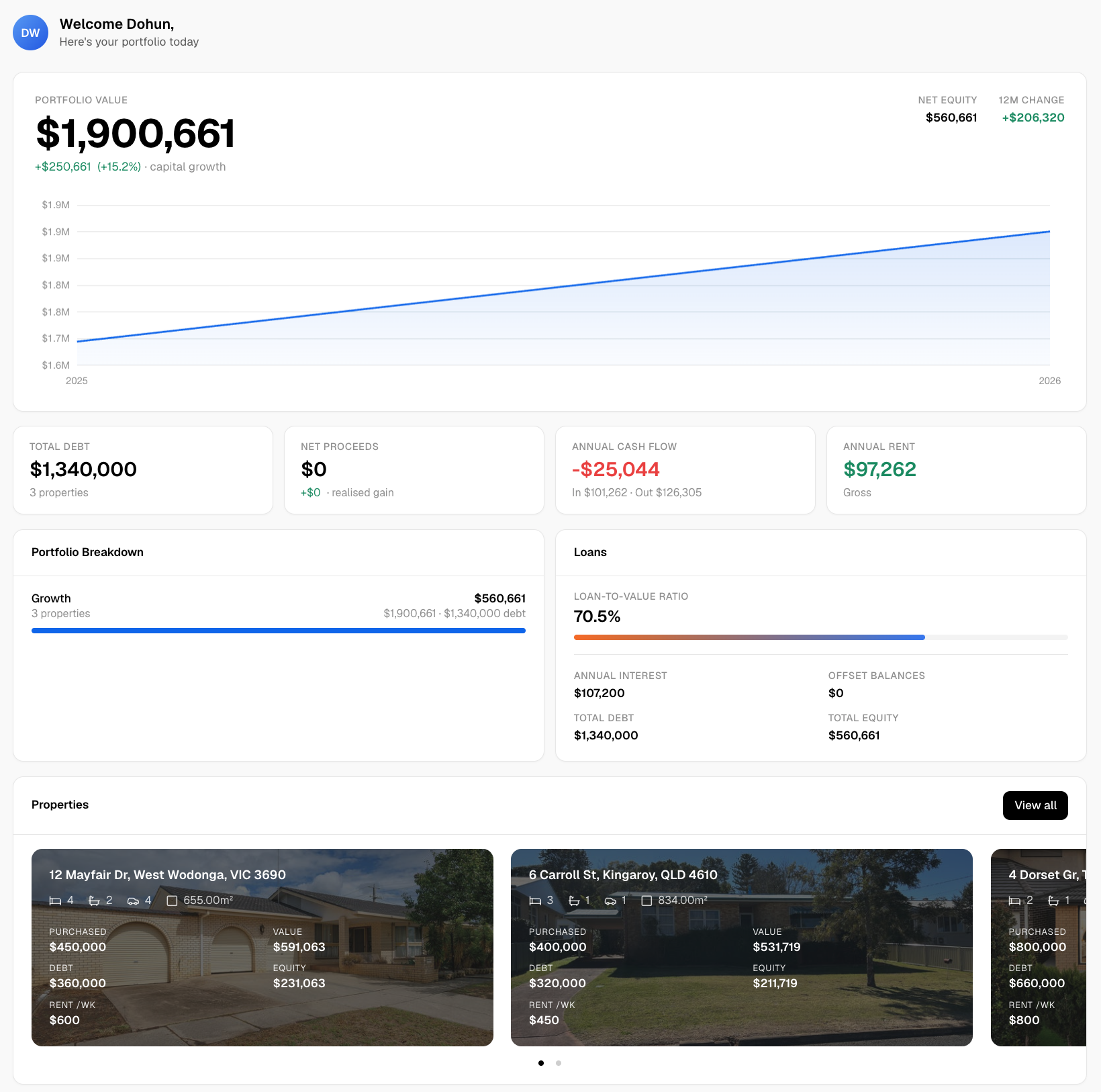
Wealthstacker is built for individual investors who want real-time clarity on their portfolio’s composition and growth trajectory. The platform provides automated quarterly property valuations at no cost, so your real estate holdings stay current within your overall allocation picture. AI-driven modelling covers both rentvesting and direct buying strategies, giving you a forecast of your net worth across different scenarios. Whether you are assessing borrowing power or comparing investment paths, Wealthstacker’s property investment app gives you the data to make allocation decisions with confidence, not guesswork.
FAQ
What is a balanced investment approach in simple terms?
A balanced investment approach splits your portfolio between growth assets, like shares and property, and defensive assets, like bonds and cash, to pursue returns while managing risk. The exact split depends on your age, goals, and how much short-term loss you can tolerate.
What is a good asset allocation for a balanced portfolio?
A common starting point is 60% growth assets and 40% defensive assets, though Australian super funds use splits ranging from 50/50 to 70/30 depending on the fund’s risk profile. Younger investors typically hold more growth assets; those near retirement hold more defensive assets.
How often should I rebalance a balanced portfolio?
Most investors rebalance semi-annually or annually. Rebalancing more frequently increases transaction costs and potential capital gains tax events without meaningfully improving returns.
Can a balanced portfolio lose money?
Yes. A balanced portfolio can still fall in value during severe market downturns, particularly when equities and bonds decline simultaneously. Diversification beyond traditional assets can reduce this risk, but no portfolio is fully protected from loss.
Is a default balanced super fund right for younger investors?
Not always. A default balanced super option may be too conservative for investors in their 20s or 30s, potentially limiting long-term accumulation. Younger investors with a long time horizon often benefit from a higher growth allocation to offset inflation risk over decades.