
What is a property investment plan? 2026 guide
TL;DR:
- A property investment plan provides a strategic framework for selecting, financing, and managing investments to achieve specific financial goals. It emphasizes setting clear SMART goals, detailed financial planning, and choosing an appropriate strategy, such as Buy-to-Let or HMO. Regular reviews and accurate projections ensure the plan remains relevant and effective for building wealth through property.
A property investment plan is a strategic blueprint that defines how you select, finance, manage, and grow investment properties to reach specific financial goals. Think of it as the difference between buying a property on a whim and building a deliberate, scalable wealth engine. Without one, most first-time investors make decisions based on emotion rather than evidence. With one, every purchase connects back to a clear target, a defined budget, and a realistic timeline. The SMART goals framework, detailed financial forecasts, and a chosen strategy, whether Buy-to-Let (BTL), HMO, or rentvesting, are the building blocks of any credible plan.
What does a property investment plan include?
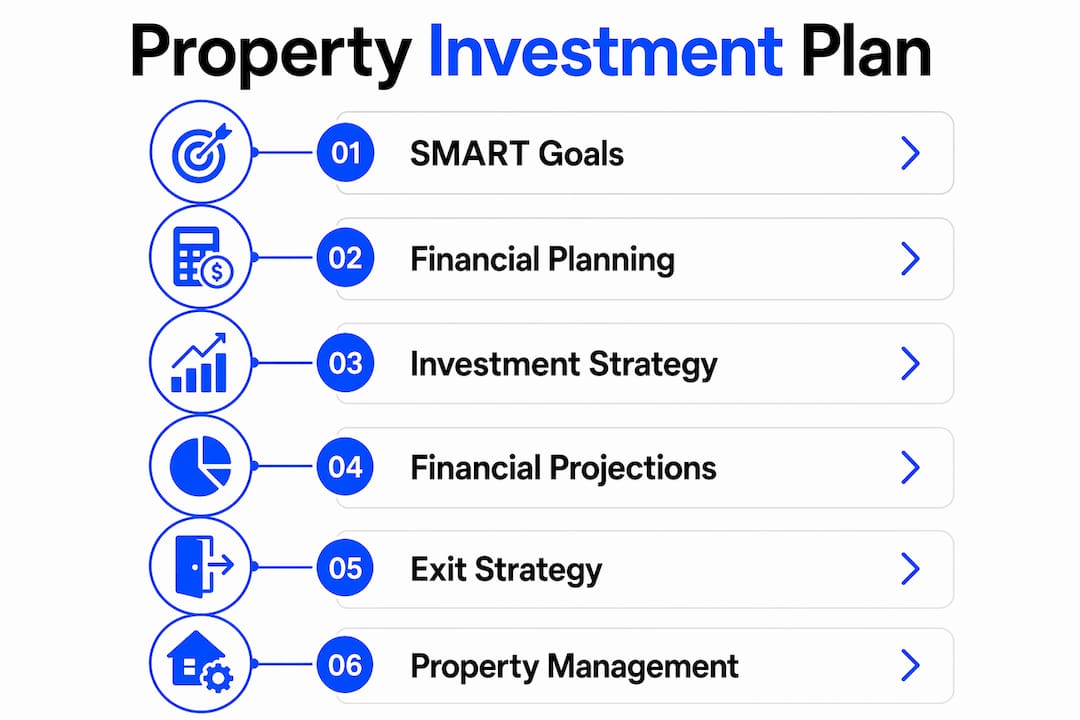
An effective property investment plan covers six core components. Each one builds on the last, turning a vague ambition into a structured investment business.
1. Investment Goals Using the SMART Framework
The SMART framework defines goals as Specific, Measurable, Achievable, Relevant, and Time-bound. Applying it to property means writing down targets like “acquire two positively geared properties in Brisbane within three years” rather than “build wealth through real estate.” Vague goals produce vague decisions. Specific goals produce specific actions.
2. Financial Planning and Budget
A foundational budget must account for a down payment of 20–25% of the property value, closing costs of around 2%, and liquid cash reserves for vacancies and repairs. These numbers are not optional buffers. They are the minimum financial floor that separates a sustainable investment from one that collapses at the first vacancy.
3. Investment Strategy and Property Type Selection

Your plan must specify which property types you will target: single-family homes, multi-family units, commercial properties, or a mix. Each type suits a different investor profile. A first-time investor with limited time typically starts with a single residential property. A more experienced investor with capital and systems might move into multi-family or commercial assets.
4. Financial Projections
Professional-grade plans include income statements, cash flow forecasts, and balance sheets spanning 3–5 years. That forecasting horizon is long enough to show whether a property genuinely performs or just looks good in year one. Lenders and partners also expect this level of detail before committing capital.
5. Exit Strategy
Every plan needs a defined exit. Will you hold and pass assets to family? Sell after a set period of capital growth? Refinance and recycle equity? Knowing your exit before you buy shapes every decision in between.
6. Property Management Plan
Decide upfront whether you will self-manage or use a property manager. Self-management saves fees but costs time. A property manager typically charges 7–10% of rental income in Australia. Factor that cost into your cash flow projections from day one.
Pro Tip: Set a specific review date every six months to revisit your plan. Markets shift, lending conditions change, and your personal finances evolve. A plan that never gets updated is just a document.
How do property investment strategies compare on risk and return?
Choosing a strategy is one of the most consequential decisions in the property investment planning process. The table below compares five common approaches used by Australian investors.
| Strategy | Typical Gross Yield | Risk Level | Management Intensity | Best Suited For |
|---|---|---|---|---|
| Buy-to-Let (BTL) | 5–8% | Low to medium | Low | Beginners, passive investors |
| HMO (House in Multiple Occupation) | 10–15%+ | Medium | High | Experienced investors with systems |
| Serviced Accommodation | 12–20%+ | Medium to high | Very high | Investors with hospitality experience |
| BRRR (Buy, Refurbish, Refinance, Rent) | Variable | Medium to high | High | Investors with renovation skills |
| Rent-to-Rent | Low upfront yield | Low capital risk | Medium | Investors with limited deposit capital |
Yield comparisons across these strategies show a clear pattern: higher returns come with higher management demands. A BTL property in a stable suburb requires minimal ongoing attention. An HMO with five tenants requires active management, compliance with additional licensing rules, and more frequent maintenance. Serviced accommodation can generate strong returns in tourist markets, but income drops sharply in low-season periods.
Strategic alignment between your risk tolerance, available time, and chosen method is what separates a coherent plan from a scattered one. Trying to run a BTL, an HMO, and a serviced accommodation property simultaneously as a beginner is a reliable way to underperform in all three. Pick one strategy, master it, then expand.
For investors comparing passive and active approaches, understanding how deals are structured across different vehicle types, from direct ownership to syndicates, adds another layer of clarity to this decision.
Why your mindset matters as much as your strategy
Shifting from a property buyer mindset to a business builder mindset is the single most important transition a new investor can make. A property buyer reacts to listings. A business builder follows a documented acquisition criteria, evaluates deals against pre-set financial targets, and builds repeatable systems.
The practical difference shows up in three areas:
- Decision-making: A business builder does not buy a property because it “feels right.” Every purchase must meet the plan’s yield, location, and cash flow criteria.
- Scaling: Documented systems, standard lease templates, and a reliable maintenance network allow you to add properties without proportionally adding stress.
- Accountability: Measurable targets create a feedback loop. If you set a goal to achieve a 6% net yield and you’re hitting 4.2%, you know exactly where to investigate.
First-time investors commonly err by trying to acquire multiple properties too quickly. The result is unsustainable management, cash flow stress, and poor tenant outcomes. Pacing acquisitions builds scale reliably. Experienced investors set milestone goals, such as one property per year, rather than chasing rapid accumulation.
Pro Tip: Write your acquisition criteria on a single page before you look at any listings. Include your target suburb profile, minimum yield, maximum purchase price, and preferred property type. If a property does not meet all four criteria, it does not go on your shortlist.
For investors exploring portfolio building while renting, this business builder mindset is especially relevant. Rentvesting, where you rent where you live and invest where the numbers work, is a strategy that only succeeds with a clear, documented plan.
How to create your property investment plan step by step
Building your own plan does not require a financial adviser or a 40-page document. It requires honest answers to a defined set of questions, in the right order.
-
Define your financial goals. Write down your target net worth, passive income figure, or number of properties, with a specific date attached to each. Use the SMART framework to test whether each goal is realistic given your current income and savings rate.
-
Audit your current finances. Calculate your borrowing capacity, existing savings, and monthly surplus. Your plan must reflect what you can actually do, not what you wish you could do.
-
Set your investment criteria. Define your “buy box”: the property type, price range, location, minimum gross yield, and preferred tenant profile. This criteria set becomes your filter for every deal you evaluate.
-
Model your cash flow before you buy. For each property you consider, project rental income, mortgage repayments, property management fees, insurance, rates, and maintenance. Understanding rental yield vs capital growth trade-offs at this stage prevents costly surprises after settlement.
-
Secure your financing structure. Decide whether you will use a standard investment loan, an offset account structure, or an interest-only period. Speak to a mortgage broker who specialises in investment lending before you make an offer.
-
Choose your management approach. Decide whether you will self-manage or appoint a property manager. Document this decision in your plan along with the cost implications.
-
Define your exit strategy. Write down the conditions under which you would sell, refinance, or transfer each property. Review this annually.
-
Schedule regular plan reviews. Set a calendar reminder every six months to update your financial projections, reassess your strategy, and check progress against your milestones.
The planning process is not a one-time event. Markets shift, interest rates move, and your personal circumstances change. A plan that gets reviewed and updated is the one that actually guides your decisions.
How Wealthstacker supports your investment planning
Building a property investment plan is straightforward in theory. Keeping it current and accurate is where most investors struggle.
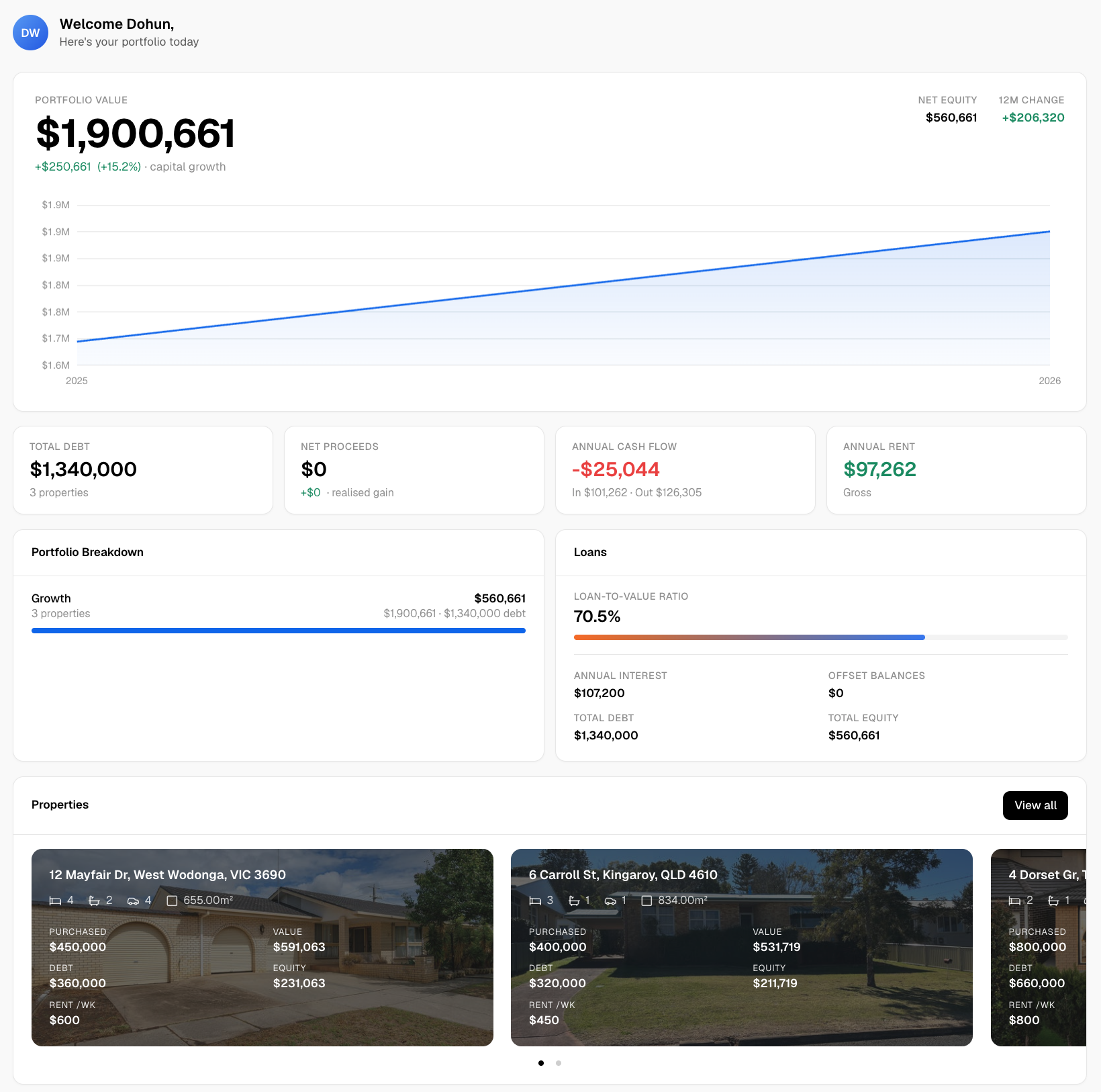
Wealthstacker is built specifically for this problem. The platform provides automated quarterly property valuations at no cost, so your financial projections always reflect current market conditions rather than the price you paid two years ago. Its AI-powered modelling tools let you compare rentvesting and buying strategies side by side, showing your projected net worth under each scenario in real time. Whether you are assessing your borrowing capacity or stress-testing a new acquisition against your existing portfolio, Wealthstacker gives you the numbers you need before you commit. Start building your plan with the Wealthstacker property investment app and see exactly where your portfolio stands today.
FAQ
What is a property investment plan in simple terms?
A property investment plan is a written strategy that outlines your financial goals, budget, chosen investment method, and timeline for building a property portfolio. It turns property investing from a series of ad hoc purchases into a structured, goal-driven process.
What should i include in a property investment plan?
A complete plan includes SMART investment goals, a detailed budget covering a 20–25% down payment and closing costs, your chosen strategy, 3–5 year financial projections, a property management approach, and a defined exit strategy.
How long should financial projections be in a property investment plan?
Financial projections should span 3–5 years and include income statements, cash flow forecasts, and balance sheets. This horizon is long enough to reveal whether a property genuinely performs beyond its first year.
Which property investment strategy suits beginners?
Buy-to-Let is the most suitable starting point for most beginners, offering gross yields of 5–8% with relatively low management demands. HMOs and serviced accommodation deliver higher returns but require more experience and active oversight.
How often should i update my property investment plan?
Review and update your plan at least every six months. Interest rates, market conditions, and your personal financial position all change, and your plan needs to reflect current reality to remain useful.
Key takeaways
A property investment plan works because it aligns your financial goals, risk tolerance, and chosen strategy into a single, documented framework that guides every acquisition decision.
| Point | Details |
|---|---|
| Define goals with SMART criteria | Specific, measurable goals produce specific decisions and prevent impulsive purchases. |
| Budget for all upfront costs | Plan for a 20–25% down payment, 2% closing costs, and cash reserves before committing. |
| Match strategy to your profile | Choose one strategy, such as BTL or HMO, that fits your time, capital, and risk tolerance. |
| Project finances over 3–5 years | Multi-year forecasts reveal true performance and satisfy lender requirements. |
| Review your plan every six months | Regular updates keep your plan aligned with market conditions and personal circumstances. |