
Property portfolio diversification strategies: 2026 guide
TL;DR:
- Property portfolio diversification involves spreading investments across different property types, locations, and income sources to reduce risk and enhance returns. Effective strategies include balancing asset classes with the 60/40 rule, geographic diversification across local, domestic, and international markets, and blending investment styles like core and opportunistic. Regular monitoring, rebalancing, and incorporating passive investments such as REITs and partnerships are essential for maintaining a resilient and optimized portfolio.
Property portfolio diversification strategies are methods to spread investment risk and improve returns by allocating capital across different property types, locations, and income structures. The industry term for this practice is portfolio asset allocation, and it applies whether you hold two properties or twenty. A well-constructed portfolio does not rely on a single market or asset class to perform. The most effective approach combines a stable core of familiar assets with deliberate exposure to growth sectors, geographic tiers, and passive income vehicles such as REITs.
1. What are the primary property portfolio diversification strategies?

Diversifying a property portfolio means spreading exposure across at least three dimensions: asset type, geography, and income structure. Residential, commercial, industrial, and mixed-use properties each respond differently to economic cycles. Holding only residential properties in one city leaves your entire portfolio exposed to a single set of local conditions.
The 60/40 asset class balance is a practical starting point. Allocate 60% of your capital to your primary area of expertise, such as residential rentals, and 30–40% to secondary sectors like commercial or industrial. This structure gives you stability where you know the market best, while still capturing growth elsewhere.
- Asset type diversification: Residential, commercial, industrial, mixed-use
- Geographic diversification: Local, domestic growth markets, international
- Income structure: Active direct ownership, passive REITs, syndications
- Investment style: Core, value-add, opportunistic
Pro Tip: Use the “core and explore” framework. Allocate 60–70% to core investments in your strongest asset class, then deploy 30–40% into higher-risk, higher-growth opportunities. Rebalance annually based on performance metrics.
2. How does geographic diversification reduce risk?
Geographic diversification is the most commonly cited strategy, but it is also the most commonly misunderstood. Owning properties in Sydney, Brisbane, and Melbourne does not guarantee diversification if all three markets depend on the same economic drivers, such as finance sector employment or government spending.
True diversification lies beneath geographic labels in economic factors: employment growth, tenant industry mix, lease rollover risk, and refinancing exposure. Two properties in different cities can be more correlated than two properties in the same suburb if their tenants work in the same industry.
A structured three-tier geographic model provides a clearer framework:
- Local (50%): Markets you know well, with direct management capability
- Domestic growth markets (30%): Cities or regions with strong population and employment growth
- International (20%): Offshore holdings that hedge against Australian macroeconomic risk
The international tier adds complexity. Short-term rental properties and offshore assets require additional management overhead, currency risk management, and local tax compliance. Start with domestic growth markets before adding international exposure.
Pro Tip: Before adding a new market, map its primary employment sectors. If they mirror your existing holdings, the geographic spread offers less protection than it appears.
3. What role do investment strategies and financing play?
Blending investment styles is as important as spreading across property types. The four main approaches each carry a distinct risk-return profile:
| Strategy | Risk level | Return profile | Typical asset |
|---|---|---|---|
| Core | Low | Stable income | Established residential |
| Core-plus | Low-medium | Income + modest growth | Suburban commercial |
| Value-add | Medium | Growth via improvement | Renovation projects |
| Opportunistic | High | High growth, variable income | Development sites |
Balanced portfolios blend core and opportunistic strategies to smooth returns across market cycles. Holding only core assets limits upside. Holding only opportunistic assets creates volatility that most investors cannot sustain through a downturn.
Financing structure matters just as much as asset selection. In high interest rate environments, prioritising cash flow properties where rents cover expenses is the most effective way to maintain portfolio resilience. Creative financing options, including seller financing, assumable mortgages, and equity partnerships, expand your access to assets without requiring full capital outlay.
Dollar-cost averaging is another underused tool. Deploying $5,000–$25,000 monthly across multiple asset types creates a smoother return profile than concentrating capital in single large purchases. This approach reduces timing risk and keeps capital working consistently.
Pro Tip: Combine at least two financing structures across your portfolio. For example, pair a standard mortgage on a core residential asset with a seller-financed deal on a value-add commercial property. This spreads both asset and financing risk.
4. How to monitor and rebalance a diversified property portfolio
A diversified portfolio without a monitoring system is just a collection of properties. Systematic oversight is what converts diversification into genuine risk management.
Quarterly financial health checks using debt-to-equity ratios and cash flow projections are the standard for professional investors. These checks reveal concentration risk before it becomes a problem and flag assets that are underperforming relative to their risk profile. Set explicit risk tolerance thresholds for each asset category before you buy, not after.
Rebalancing is the mechanism that keeps your allocation on track. If your residential holdings outperform and grow to 80% of portfolio value, your intended diversification has eroded. A rebalancing framework should trigger a review when any single asset class exceeds its target weighting by more than 10%.
- Set target weightings for each asset class and geographic tier at the start of each financial year
- Review quarterly using debt-to-equity ratios, vacancy rates, and cash flow against projections
- Identify drift when any category moves more than 10% from its target allocation
- Act on drift by redirecting new capital or selectively divesting overweight positions
- Document decisions to build a record that informs future rebalancing
Portfolio tracking tools, including apps that provide automated valuations and scenario modelling, make this process far less time-consuming. Wealthstacker provides automated quarterly valuations that give investors current market data without manual research.
Pro Tip: Track lease rollover dates across your entire portfolio on a single calendar. Concentrated lease expiries in the same quarter create refinancing and vacancy risk that geographic diversification alone cannot solve.
5. What are the overlooked diversification strategies for 2026?
Several effective diversification approaches receive far less attention than geographic spread or asset type. These are worth building into your strategy now.
ESG integration is moving from optional to expected in institutional portfolios. Properties with strong environmental credentials attract higher-quality tenants, command premium rents, and face lower obsolescence risk. The role of ESG in asset allocation is now a mainstream consideration for portfolio construction, not just a values-based preference.
Income timing diversification is another overlooked dimension. If all your properties have leases expiring in the same period, your income stream is vulnerable regardless of how many assets you hold. Stagger lease terms across your portfolio to smooth income and reduce refinancing pressure.
Passive investment vehicles such as REITs and property syndications provide liquidity that direct property ownership cannot. Mixing active and passive investments enhances liquidity and allows dollar-cost averaging, which reduces the impact of market timing on overall returns. REITs also provide exposure to commercial and industrial sectors without the management overhead of direct ownership.
The most common diversification mistake is treating a geographic spread as a complete strategy. Properties in different cities with the same tenant industries, similar lease structures, and identical financing terms are not truly diversified. Genuine diversification operates across economic drivers, income timing, and capital structure simultaneously.
Creative partnership structures give investors access to larger or higher-quality assets than they could acquire alone. Joint ventures and equity partnerships allow you to participate in portfolio building while renting or while capital is constrained, without sacrificing diversification.
Technology tools for scenario planning are now accessible to individual investors, not just institutions. Platforms that model portfolio performance under different interest rate and vacancy assumptions let you stress-test your allocation before committing capital.
Key takeaways
Effective property portfolio diversification requires simultaneous management of asset type, geographic tier, income structure, and financing strategy, not just a spread of locations.
| Point | Details |
|---|---|
| Use the core and explore framework | Allocate 60–70% to your strongest asset class, then diversify 30–40% into growth sectors. |
| Apply the three-tier geographic model | Split holdings 50% local, 30% domestic growth markets, and 20% international for macro-risk coverage. |
| Blend investment styles | Combine core and opportunistic assets to smooth returns across different market cycles. |
| Monitor quarterly, rebalance annually | Use debt-to-equity ratios and cash flow projections to catch concentration risk early. |
| Diversify income structure | Add REITs or syndications to improve liquidity and reduce reliance on direct property income. |
Build your diversified portfolio with Wealthstacker
Knowing the right strategy is only half the work. Executing it requires current data, clear modelling, and a system that keeps your allocation on track as markets move.
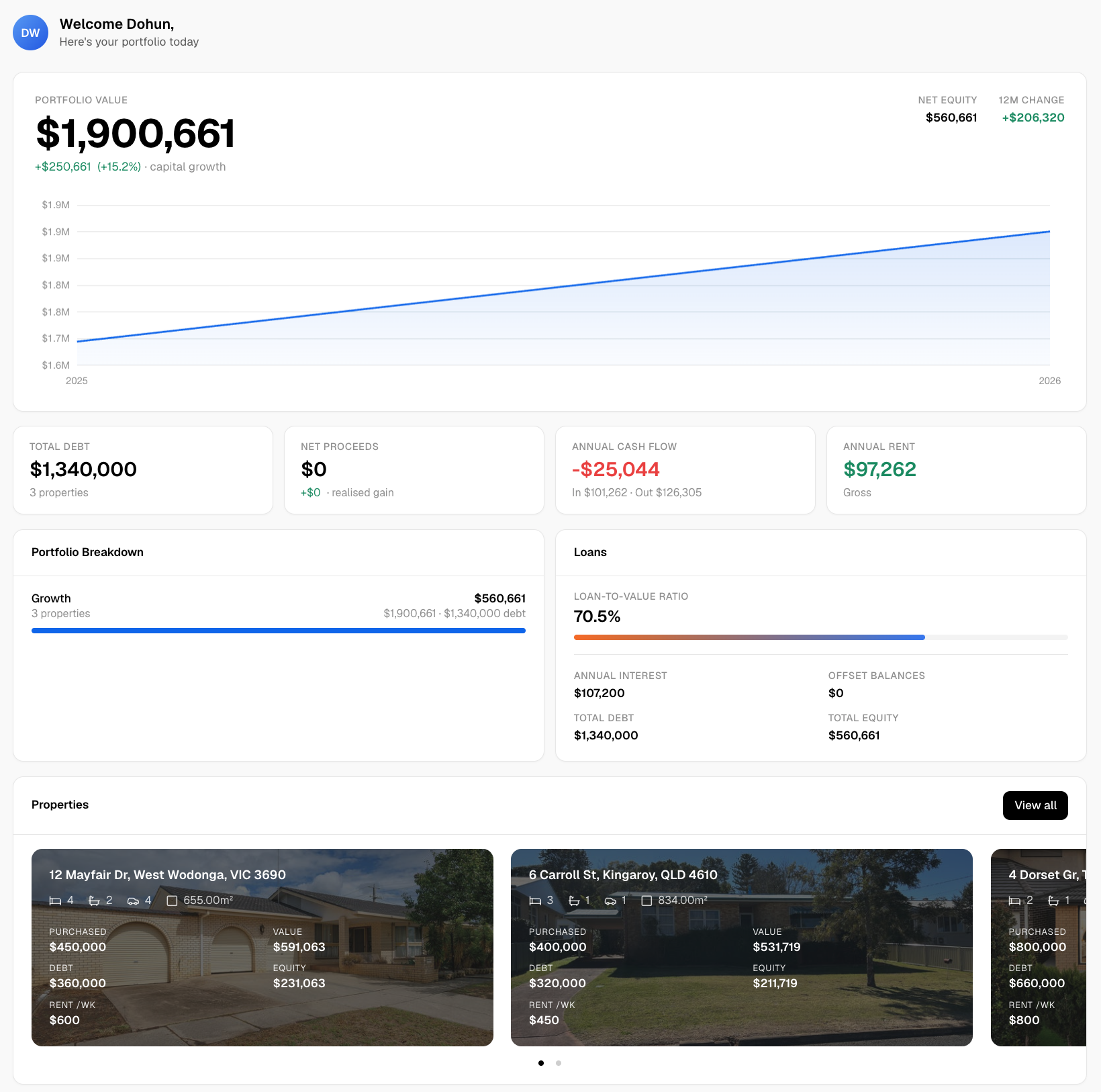
Wealthstacker is built for investors who take portfolio construction seriously. The platform provides automated quarterly valuations at no cost, real-time net worth modelling, and scenario planning tools that show how different allocation decisions affect your long-term wealth. Whether you are comparing rental yield vs capital growth across asset classes or stress-testing your portfolio against rate changes, Wealthstacker gives you the data to act with confidence. Visit Wealthstacker to start tracking and optimising your property portfolio today.
FAQ
What is the best way to diversify a real estate investment portfolio?
The most effective approach combines asset type diversification, a three-tier geographic model, and a mix of active and passive income sources. Allocate 60–70% to your core expertise and spread the remainder across growth sectors and passive vehicles like REITs.
How often should I rebalance my property portfolio?
Conduct quarterly financial health checks using debt-to-equity ratios and cash flow projections, and rebalance when any asset class drifts more than 10% from its target weighting. Annual formal rebalancing is the standard for most investors.
Does geographic diversification alone reduce property risk?
Geographic diversification is insufficient on its own. Properties in different cities with similar economic drivers, such as the same tenant industries or employment base, remain highly correlated and carry similar risk profiles.
What is the core and explore strategy in property investing?
The core and explore strategy allocates 60–70% of capital to a familiar, stable asset class for consistent cash flow, with 30–40% deployed into higher-risk or alternative sectors to capture growth across different market cycles.
How do REITs fit into a diversified property portfolio?
REITs provide liquidity, sector exposure, and the ability to deploy capital via dollar-cost averaging, which direct property ownership cannot match. They are most useful for gaining commercial or industrial exposure without the management demands of direct ownership.