Portfolio building while renting: your 2026 guide

Portfolio building while renting is the practice of using your rental living situation as a financial lever to grow income-producing assets, rather than waiting until you own a home to start investing. Renters in Australia have two primary paths: rentvesting, where you own an investment property while renting your home, and the rent-and-invest method, where you direct the cost gap between renting and owning into diversified assets. With 2026 superannuation cap changes now in effect, the tax advantages available to renters have never been stronger. The strategies below give you a clear framework to act on.
1. what is rentvesting and how does it work?
Rentvesting means renting where you live while owning an investment property chosen purely on financial fundamentals. You pick your rental based on lifestyle factors like proximity to work, schools, or social life. You pick your investment property based on yield, growth potential, and borrowing capacity.
This separation is the core advantage. Most owner-occupiers compromise on both fronts, buying in a suburb they can afford rather than one they want to live in, while also accepting lower investment returns. Rentvesting lets you optimise each decision independently.
Key benefits and risks to understand:
- Rental income from your investment property offsets holding costs
- Tax deductions on interest, depreciation, and property expenses reduce your taxable income
- Landlord obligations add operational complexity, including tenant management and maintenance
- Vacancy risk can disrupt cashflow if the property sits empty between tenants
- Borrowing capacity may be affected by your rental commitments
Rentvesting suits a 5+ year horizon because transaction costs, including stamp duty and agent fees, erode short-term gains. If you plan to move cities or change lifestyle significantly within two years, the rent-and-invest approach is likely more flexible.
Pro Tip: When evaluating an investment property for rentvesting, use rental yield and vacancy rate data from the suburb, not just the purchase price. A property yielding 5% in a regional centre often outperforms a 2.5% yielding inner-city apartment on cashflow.
2. how automation turns the rent-own gap into a portfolio
The rent-and-invest method works by calculating the difference between what you would pay to own a comparable home and what you currently pay in rent, then investing that gap every single fortnight. Automated investing prevents lifestyle creep and keeps contributions consistent regardless of market mood or spending temptation.
Here is how to implement it in four steps:
- Calculate your gap. Estimate the full cost of owning a comparable property, including mortgage repayments, council rates, insurance, and maintenance. Subtract your current rent. That difference is your investable surplus.
- Automate the transfer. Set up a recurring bank transfer on the same day your rent is paid. Treat it as a non-negotiable bill.
- Invest in low-cost index funds or ETFs. Vanguard, iShares, and BetaShares all offer diversified Australian and global index funds with management fees below 0.20% per annum.
- Review every six months. Check your allocation, rebalance if needed, and increase contributions when your income rises.
Consistency in investing the housing gap is the single biggest determinant of long-term wealth for renters. A renter who invests $1,000 per fortnight for 20 years in a diversified portfolio growing at 7% per annum accumulates significantly more than one who invests sporadically.
Pro Tip: Automate at the same cadence as your rent payments. If rent goes out every fortnight, your investment transfer should go out the same day. This enforces a discipline that manual investing rarely achieves.

3. what the 2026 super cap changes mean for renters
The 2026 superannuation changes are the most significant tax planning opportunity for Australian renters in years. From 1 July 2026, concessional contributions rise to $32,500 per year, up from $30,000. Non-concessional contributions rise to $130,000 per year, up from $120,000.
The bring-forward rule also increases. Eligible individuals can now contribute up to $390,000 in non-concessional contributions over three years in a single financial year. That is a meaningful amount of after-tax money that can be sheltered inside a concessional tax environment.
| Contribution Type | 2025–26 Cap | 2026–27 Cap | Bring-Forward (3 years) |
|---|---|---|---|
| Concessional | $30,000 | $32,500 | N/A |
| Non-concessional | $120,000 | $130,000 | $390,000 |
Renters benefit from this more than owner-occupiers in one specific way. Without a mortgage to service, renters often have more discretionary income available to direct into super. The tax rate on concessional contributions inside super is 15%, compared to marginal rates of 32.5% or higher for most working Australians. Strategic contribution timing around these new caps can compound into substantial tax savings over a decade.
4. how negative gearing affects your investment property portfolio
Negative gearing is a tax strategy where the costs of holding an investment property exceed the rental income it generates. Rental losses reduce your taxable income, which lowers your annual tax bill. For high-income earners in the 37% or 45% marginal tax brackets, this reduction is material.
The capital gains tax discount adds another layer. Hold your investment property for more than 12 months and you qualify for a 50% CGT discount on any gain when you sell. A property that grows by $200,000 in value would only attract CGT on $100,000 of that gain for an individual investor.
The cautions are real, though:
- Policy risk is genuine. Negative gearing rules have been debated in every federal election cycle for a decade. Stress-test your investment assuming the deduction is reduced or removed.
- Cashflow still matters. A negatively geared property still requires you to fund the shortfall every month. If your rental income drops due to vacancy, you carry the full cost.
- Tax benefits are a bonus, not a business case. The property must make financial sense without the deduction. If it only works because of negative gearing, the risk profile is too high.
5. liquidity and diversification: the renter’s hidden advantage
Renting keeps your capital liquid. Homeownership carries hidden costs of around $15,979 annually beyond the mortgage, covering maintenance, rates, insurance, and repairs. Renters who invest those savings instead build a diversified portfolio rather than concentrating all wealth in a single illiquid asset.
The comparison below illustrates the trade-off between concentrated property ownership and a diversified renter portfolio:
| Approach | Liquidity | Diversification | Leverage Available |
|---|---|---|---|
| Owner-occupier | Low | Low (single asset) | High (mortgage) |
| Rentvesting | Medium | Medium (property + super) | High (investment loan) |
| Rent and invest | High | High (shares, ETFs, bonds) | Low to medium |
Concentrated property exposure is the most common wealth-building mistake in Australia. A single investment property in one suburb ties your net worth to the performance of that postcode. A diversified portfolio across Australian shares, global equities, and fixed income reduces that concentration risk significantly.
For renters considering rental portfolio financing, maintaining a cash buffer of three to six months of expenses is non-negotiable. This protects you from forced selling during market downturns or vacancy periods.
6. tracking rental yield vs capital growth in your portfolio
Understanding the difference between rental yield and capital growth is fundamental to evaluating any investment property. Rental yield measures the annual income a property generates as a percentage of its value. Capital growth measures how much the property’s value increases over time.
Most Australian investors chase capital growth in major cities and accept low yields of 2–3%. Regional and outer suburban properties often deliver yields of 5–6% with more modest growth. Neither approach is universally superior. The right balance depends on your cashflow needs, tax position, and time horizon.
For renters building a portfolio, rental yield versus capital growth is a decision that shapes your entire investment strategy. A high-yield property funds itself and generates positive cashflow from day one. A high-growth property builds equity faster but may require ongoing top-up payments.
Pro Tip: Model both scenarios before committing. A property that yields 5% and grows at 4% per annum often outperforms a 2.5% yield and 7% growth property on a total return basis over 10 years, once you account for the compounding effect of reinvested income.
7. behavioural discipline: the factor that separates winners from drifters
Behavioural discipline is the most underrated factor in building wealth as a renter. The rent-and-invest strategy requires you to maintain consistent contributions without the forced savings mechanism that a mortgage provides. Automation prevents lifestyle creep and maintains investment consistency across market cycles.
The six-monthly review is not optional. Every six months, check your portfolio allocation, confirm your contributions have kept pace with any income increases, and rebalance if any asset class has drifted more than 5% from your target. This review also keeps your financial goals front of mind, which research consistently links to better long-term outcomes.
Renters who treat their investment contributions as fixed expenses, not discretionary spending, accumulate wealth at the same rate as disciplined mortgage holders. The mechanism is different but the outcome is comparable.
Key takeaways
Renting and investing simultaneously works best when you combine automation, tax efficiency, and a clear separation between lifestyle choices and investment decisions.
| Point | Details |
|---|---|
| Rentvesting separates lifestyle from investment | Choose your rental for life factors and your investment property on financial fundamentals alone. |
| Automate the rent-own gap | Invest the difference between renting and owning costs automatically, on the same schedule as your rent. |
| 2026 super caps favour renters | Concessional cap rises to $32,500 and non-concessional to $130,000; use the bring-forward rule to maximise tax efficiency. |
| Negative gearing needs stress-testing | Model your investment property assuming reduced tax benefits to confirm it still makes financial sense. |
| Liquidity is a renter’s structural advantage | Avoid concentrating all wealth in one property; diversify across shares, ETFs, and super for resilience. |
Why renters have the upper hand right now
I have spent years watching people delay investing because they assumed homeownership had to come first. That assumption has cost a lot of Australians a decade of compounding returns.
The honest truth is that renting gives you something most homeowners do not have: flexibility and liquid capital. A homeowner with $800,000 in equity has paper wealth. A renter with $400,000 spread across a diversified portfolio and a growing super balance has real, deployable wealth.
What I have found actually works is the combination of automation and a clear written plan. Renters who write down their target allocation, set up automatic transfers, and review every six months consistently outperform those who invest manually and reactively. The discipline is the strategy.
The 2026 super changes are genuinely exciting for renters in the accumulation phase. The bring-forward rule at $390,000 is a meaningful opportunity to shelter a large lump sum inside a low-tax environment. If you have savings sitting in a high-interest account earning 4.5% and paying 37% tax on the interest, moving that money into super at a 15% tax rate is a straightforward win.
My one caution: do not let the tax tail wag the investment dog. Negative gearing and super concessions are tools, not strategies. The underlying asset still needs to make sense on its own merits.
— Dohun
See your wealth trajectory with Wealthstacker
Knowing the right strategy is one thing. Seeing exactly how your choices play out in dollar terms is what drives real decisions.
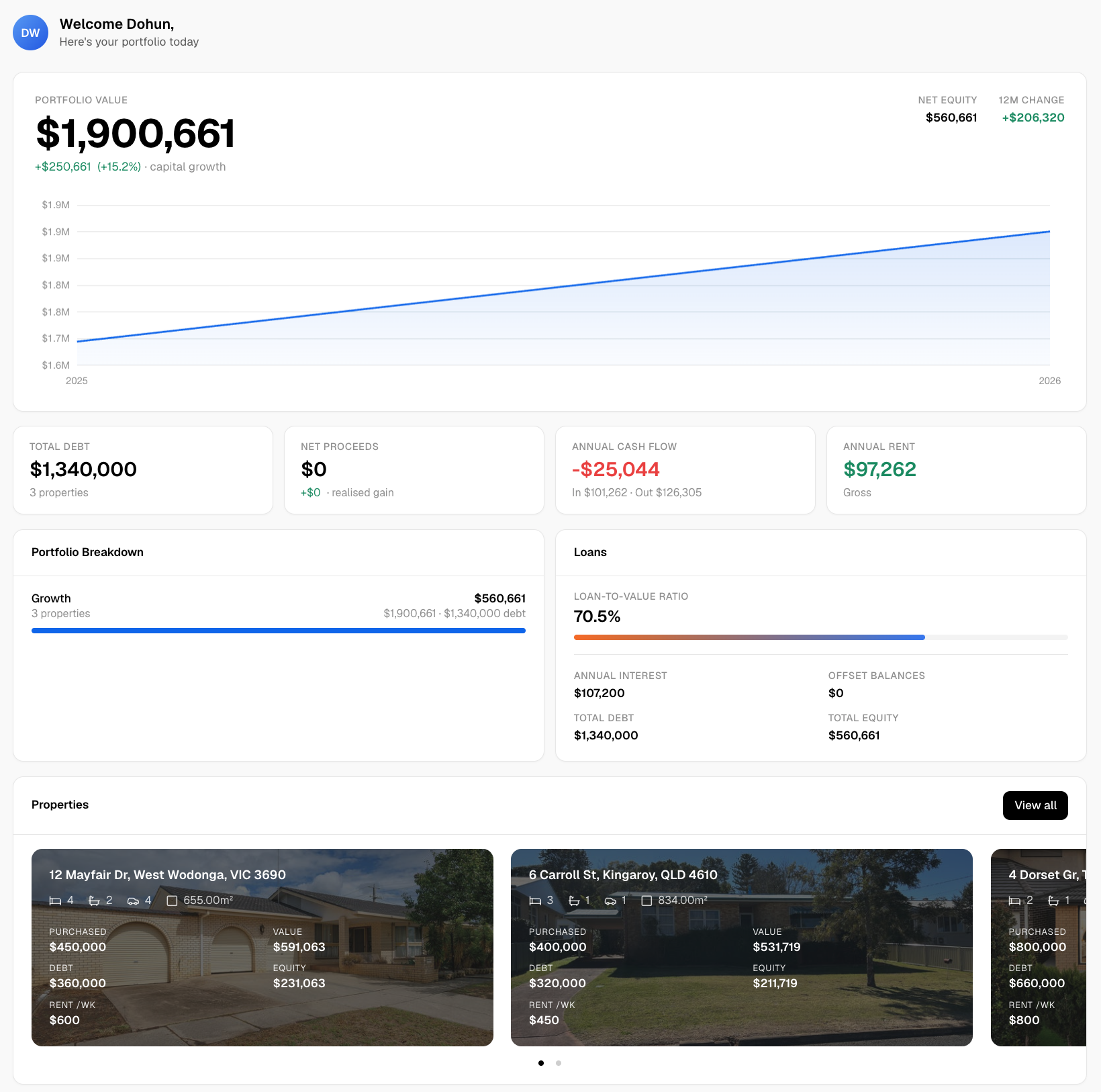
Wealthstacker is built specifically for renters who want to model rentvesting and rent-and-invest scenarios side by side. The platform provides automated quarterly property valuations, real-time net worth modelling, and personalised forecasts for both strategies. You can calculate your rent-versus-own gap, test different contribution levels, and see projected wealth accumulation over 10, 20, and 30 years. For renters serious about building their investment portfolio, Wealthstacker removes the guesswork and replaces it with data.
FAQ
What is rentvesting in australia?
Rentvesting means renting your home for lifestyle reasons while owning an investment property chosen on financial fundamentals. It is popular in Australia and best suited to investors with a 5+ year time horizon.
Can renters build wealth without buying a home?
Yes. Renters who invest the cost difference between renting and owning into diversified assets like index funds and ETFs can build comparable wealth to owner-occupiers over time. Automation and consistency are the critical factors.
How do the 2026 super changes help renters?
From 1 July 2026, the concessional cap rises to $32,500 and the non-concessional cap to $130,000. Renters with surplus cashflow can use the bring-forward rule to contribute up to $390,000 in a single year at a concessional 15% tax rate.
Is negative gearing worth it for renters investing in property?
Negative gearing reduces taxable income and pairs with the 50% CGT discount after 12 months of ownership. However, tax policy can change, so always model your investment assuming the deduction is reduced before committing.
How often should renters review their investment portfolio?
Review your portfolio every six months. Check your asset allocation, confirm contributions have kept pace with income growth, and rebalance if any asset class has drifted more than 5% from your target.