
First home buyer investment strategies: 2026 guide
TL;DR:
- First-time buyers in Australia can realistically access property investment in 2026 through strategic buy and hold, rentvesting, or renovation.
- Choosing the right approach depends on income, lifestyle, and risk tolerance, with government schemes favoring owner-occupiers.
Getting into the Australian property market as a first-time buyer is genuinely achievable in 2026, and the strategies that work best depend on your income, lifestyle, and how much risk you can carry. The three core approaches are buy and hold (purchasing a rental property and holding it for capital growth and income), rentvesting (renting where you want to live while owning an investment property in a more affordable area), and renovation for value-add (buying below market value and improving the asset). Each path has a different tax profile, deposit requirement, and lifestyle trade-off.
Key considerations before choosing a strategy:
- Government support: The 5% Deposit Scheme lets eligible first home buyers purchase with a 5% deposit and no Lenders Mortgage Insurance, but only for owner-occupied purchases.
- Deposit and borrowing: Investment loans typically require a 10–20% deposit, higher interest rates, and no first home buyer concessions.
- Owner-occupied vs investment: Buying to live in preserves your eligibility for grants and stamp duty concessions; buying as an investment forfeits most of that.
- Equity and wealth: All three strategies build equity over time, but the tax treatment differs significantly, particularly around capital gains.
The right strategy is rarely the one with the highest projected return. It is the one you can actually execute, hold through a rate cycle, and sustain financially for at least five years.
What are the main property investment strategies for first home buyers?
Buy and hold
Buy and hold means purchasing a rental property, finding a tenant, and holding the asset for years while collecting rent and waiting for capital growth. The income offsets your mortgage costs, and over a long hold period, the compounding effect of rising property values builds equity. The tax treatment is straightforward: rental income is assessable, and most property expenses including mortgage interest, rates, and management fees are deductible. If the property is negatively geared (costs exceed income), that loss offsets other taxable income.
Pros:
- Passive income once tenanted
- Deductible expenses reduce taxable income
- Capital growth over long hold periods
Cons:
- Requires ongoing cash to cover shortfalls, maintenance, and vacancy periods
- No access to first home buyer grants or stamp duty concessions
- Higher deposit requirement than owner-occupied purchases
Pro Tip: Focus on suburbs with strong rental demand and diverse employment rather than areas you personally find appealing. Tenants prioritise transport, schools, and proximity to work, not the same things you might.
Rentvesting

Rentvesting lets you rent in the suburb you actually want to live in while owning an investment property somewhere the numbers make sense. It is particularly effective when the gap between your lifestyle suburb and an affordable investment suburb is large. A buyer renting in inner Sydney but owning in regional Queensland, for example, gets property market exposure without waiting a decade to save a deposit for their preferred area.
Tax deductions available to rentvestors include mortgage interest, property management fees, and depreciation on the building and fittings. These deductions are unavailable on an owner-occupied home. The catch is that buying an investment property first typically forfeits your first home buyer scheme eligibility permanently in most states.
Pros:
- Enter the property market sooner in a more affordable location
- Tax deductions on investment property expenses
- Lifestyle flexibility to live where you want
Cons:
- Forfeits first home buyer grants and stamp duty concessions in most states
- No CGT exemption on the investment property
- Requires disciplined investing of any cash flow surplus to make the strategy work
Renovation for value-add
Buying a property below market value, renovating it, and either selling or refinancing against the improved equity is a faster path to wealth than passive holding, but it carries more risk and requires hands-on management. The strategy works best when you buy in a suburb where renovated properties command a clear premium, and when you keep renovation costs tightly controlled.
Pros:
- Can manufacture equity faster than waiting for market growth
- Refinancing against new equity releases capital for a second purchase
- Adds rental appeal if held as an investment
Cons:
- Renovation costs frequently blow out
- Requires time, expertise, or reliable tradespeople
- Capital gains tax applies on sale unless it is your principal place of residence
How do government schemes support first home buyer property investors?
The Australian Government’s 5% Deposit Scheme is the most significant support available to first home buyers in 2026. From 1 October 2025, the scheme expanded to remove income caps, uncap the number of places, and increase property price caps across all states. In Sydney, the property price cap is $1.5 million, and in Melbourne it is $950,000 from October 2025. Single parents can access the scheme with a deposit as low as 2%.
Key figure: First home owner-occupiers who access grants, stamp duty concessions, and the First Home Guarantee typically save $20,000–$60,000 or more in upfront costs compared to buyers without scheme access.
Eligible buyers under the scheme’s General Stream include first home buyers and those who have not owned property in the past ten years. The critical constraint: every scheme requires the property to be owner-occupied. Buying as an investment from day one disqualifies you from the First Home Guarantee, most state grants, and stamp duty concessions.
State-level support varies considerably:
- Victoria: Stamp duty concessions and grants for new builds up to specific price thresholds.
- ACT: The Home Buyer Concession Scheme offers duty concessions for eligible buyers.
- NSW, QLD, WA, SA, NT, TAS: Grants of $10,000–$30,000 for new builds, subject to price and residency conditions.
The First Home Super Saver Scheme (FHSS) sits alongside these. It lets buyers make voluntary superannuation contributions up to a total cap of $50,000 and withdraw those contributions and associated earnings when purchasing their first home, taking advantage of the concessional tax rate inside super.
Pro Tip: If you plan to rentvest, check your state’s specific eligibility rules before purchasing. Some FHSS provisions may still be accessible even after buying an investment property, but most grant and stamp duty schemes will not be.
How to buy your first investment property: a step-by-step process
-
Assess your finances. Calculate your savings, monthly surplus, and existing debts. Know your borrowing capacity before approaching lenders. Investment loans typically require a 10–20% deposit, and on a $500,000 property, total upfront costs including stamp duty, conveyancing, and inspections can reach $130,000–$150,000 depending on the state.
-
Understand investment loan requirements. Investment mortgages carry higher interest rates than owner-occupier loans and stricter income assessment. There are no first home buyer concessions on stamp duty for investment purchases. Get pre-approval before searching so you know your ceiling.
-
Research investment locations. Focus on suburbs with strong rental demand, transport access, and proximity to schools and employment rather than personal preference. Rental demand and transport access are the two factors that most consistently predict both yield and capital growth.
-
Inspect properties and run the numbers. Attend inspections, commission building and pest reports, and model the cash flow before making an offer. Wealthstacker’s AI-powered valuation tools let you model property returns and compare scenarios across different suburbs and price points, which removes a lot of the guesswork from this stage.
-
Make an offer and review the contract. Engage a conveyancer or solicitor before signing anything. Review special conditions, settlement terms, and any easements or encumbrances on the title. Negotiate on price where the due diligence supports it.
-
Prepare for settlement. Arrange landlord insurance before settlement, not after. Engage a property manager if you are not managing the tenancy yourself. Set up a separate account for rental income and expenses to simplify tax time.
Common mistakes first home buyers make with investment property
Avoiding these errors separates buyers who build genuine wealth from those who stall after the first purchase.
- Overextending financially. Underestimating ongoing costs including maintenance, property management fees, council rates, and insurance is the most common mistake. Add a buffer for vacancy periods and unexpected repairs before committing to a purchase.
- Forfeiting first home buyer benefits without realising it. Buying an investment property first permanently removes eligibility for most state grants and stamp duty concessions. Understand what you are giving up before you decide.
- Choosing the wrong location. Buying in an area you like rather than one tenants want leads to extended vacancies and weak capital growth. Prioritise rental demand, infrastructure, and employment diversity.
- Ignoring vacancy and management costs. A property sitting empty for six weeks a year costs more than most buyers budget for. Factor in property management fees (typically 7–10% of rent) and realistic vacancy rates.
- Neglecting tax implications. Capital gains tax applies on investment property sales. Negative gearing rules affect your tax position each year. Not understanding these before purchase leads to surprises at tax time.
- Overestimating growth without evidence. Projecting strong capital growth in a suburb without population growth, infrastructure investment, or rental demand is wishful thinking. Base projections on data, not optimism.
- Failing to invest the cash flow surplus when rentvesting. Disciplined investment of any surplus between your rent paid and rent received is what makes rentvesting outperform over time. Lifestyle creep absorbing that surplus is a key reason the strategy underperforms for many buyers.
What the research says about building wealth through property
The principal place of residence (PPOR) holds a structural tax advantage that investment property cannot match. The CGT exemption on your main residence means every dollar of capital growth on your home is tax-free on sale, provided you have lived there continuously. For investment properties, capital gains tax applies, though the 50% CGT discount applies after a 12-month hold.
Tax planning lever: The 6-year absence rule allows buyers who occupy a property as their PPOR for at least six months before renting it out to maintain the CGT exemption for up to six years. This is one of the most underused tax advantages available to first home buyers who later convert their home to a rental.
Defensible investment properties share a consistent set of characteristics: strong gross rental yield, population growth in the local government area, a diverse employer base, and an active infrastructure pipeline. Single-industry towns carry concentration risk; diverse local economies hold value through downturns.
Wealthstacker’s AI-driven valuation and portfolio tracking tools let buyers model realistic cash flow and equity growth across different scenarios, including rate rises, vacancy periods, and renovation costs. Running those scenarios before purchase, rather than after, is what separates confident decisions from expensive guesses.
Pro Tip: Time the sale of an investment property to coincide with a lower-income year. Because capital gains are added to your assessable income in the year of sale, selling in a year when your other income is lower reduces the effective tax rate on the gain.
How should first home buyers assess and manage investment risk?
Property investment carries real financial risk, and first home buyers face it with less capital buffer than experienced investors. The most practical risk management framework starts with stress-testing your cash flow at interest rates 2–3 percentage points above your current rate. If the numbers only work at today’s rate, the investment is fragile.
Diversifying risk means not concentrating all your capital in a single property type or location. A unit in a high-supply corridor carries different risk to a house in a low-vacancy suburban market. Landlord insurance covers loss of rent, malicious damage, and liability, and the annual premium is tax-deductible. Building and pest inspections before purchase catch structural issues that can turn a good deal into a costly one.
Liquidity risk is specific to property: you cannot sell 10% of a house if you need cash. Maintain a cash reserve of at least three to six months of mortgage repayments before purchasing. That buffer absorbs vacancy periods, rate rises, and unexpected repairs without forcing a distressed sale.
Long-term financial planning for first home buyers building property wealth
Property investment works best as part of a broader financial plan, not as a standalone bet. The most effective approach integrates superannuation contributions (including the FHSS scheme for deposit saving), debt reduction, and property acquisition across a 10–20 year horizon. Buying one well-chosen property and holding it through multiple market cycles consistently outperforms buying and selling frequently, largely because transaction costs and CGT erode returns on short holds.
Equity released through refinancing after capital growth funds the deposit on a second property. That compounding effect, buying, holding, refinancing, and buying again, is how most successful Australian property investors build portfolios. The role of leverage in this process is significant: borrowing to buy an appreciating asset amplifies returns in a way that cash savings alone cannot replicate.
Review your portfolio annually. Reassess rental yields, outstanding loan balances, and property values. Wealthstacker’s automated quarterly valuations give you current market data without paying for a formal appraisal each time.
When should you sell or refinance an investment property?
Selling makes sense when the property’s capital growth has plateaued, the yield has compressed below what you could achieve elsewhere, or you need the equity to fund a more valuable purchase. The 50% CGT discount applies after 12 months of ownership, so holding for at least that period before selling is a baseline rule. Timing the sale to a low-income year, as noted earlier, reduces the tax bill further.
Refinancing is the alternative to selling. If the property has grown in value, refinancing against the new equity releases capital without triggering a CGT event. That capital can fund a deposit on a second property, a renovation, or other investments. The trade-off is higher total debt and increased monthly repayments.
Converting an investment property to your PPOR is a third path. Moving into the property restarts the main-residence CGT exemption from the move-in date. Any pre-move-in capital gain remains on the books until eventual sale, but future growth from that point is tax-free.
How do interest rate changes affect your investment property returns?
Interest rates directly affect both your borrowing capacity and your monthly cash flow. When rates rise, the gap between rental income and mortgage repayments widens, increasing the cash you need to contribute each month. On a variable-rate investment loan, a 1% rate increase on a $500,000 loan adds roughly $5,000 per year to your interest bill.
Fixed-rate periods offer short-term certainty but create refinancing risk when the fixed term expires. Most investment loans revert to a variable rate after one to five years, and if rates have risen in that period, the jump in repayments can be significant. Stress-testing your cash flow at higher rates before purchasing, not after, is the most practical protection against this.
Rental income tends to rise with inflation over time, which provides a partial natural hedge against rate increases. In markets with low vacancy rates, landlords can increase rents more readily, which partially offsets higher mortgage costs. The relationship is not immediate, but over a full rate cycle, rental growth typically catches up.
Key takeaways
First home buyer investment strategies in Australia require choosing between owner-occupied and investment pathways early, because that decision determines your eligibility for government schemes worth up to $60,000 in savings.
| Point | Details |
|---|---|
| Government scheme eligibility | The 5% Deposit Scheme allows eligible first home buyers to purchase with only a 5% deposit, bypassing Lenders Mortgage Insurance, but only for owner-occupied homes. Property price caps are $1.5 million in Sydney and $950,000 in Melbourne from October 2025. Buying as an investment first forfeits most grants and concessions. |
| Upfront investment costs | On a $500,000 investment property, total upfront costs including deposit and fees can reach $130,000–$150,000 depending on the state. |
| CGT exemption on PPOR | Your principal place of residence is fully exempt from capital gains tax; investment properties are not. |
| 6-year absence rule | Occupying a property for at least six months before renting it out preserves the CGT exemption for up to six years. |
| Rentvesting trade-off | Rentvesting builds equity in affordable markets but forfeits first home buyer benefits worth $20,000–$60,000 or more in most states. |
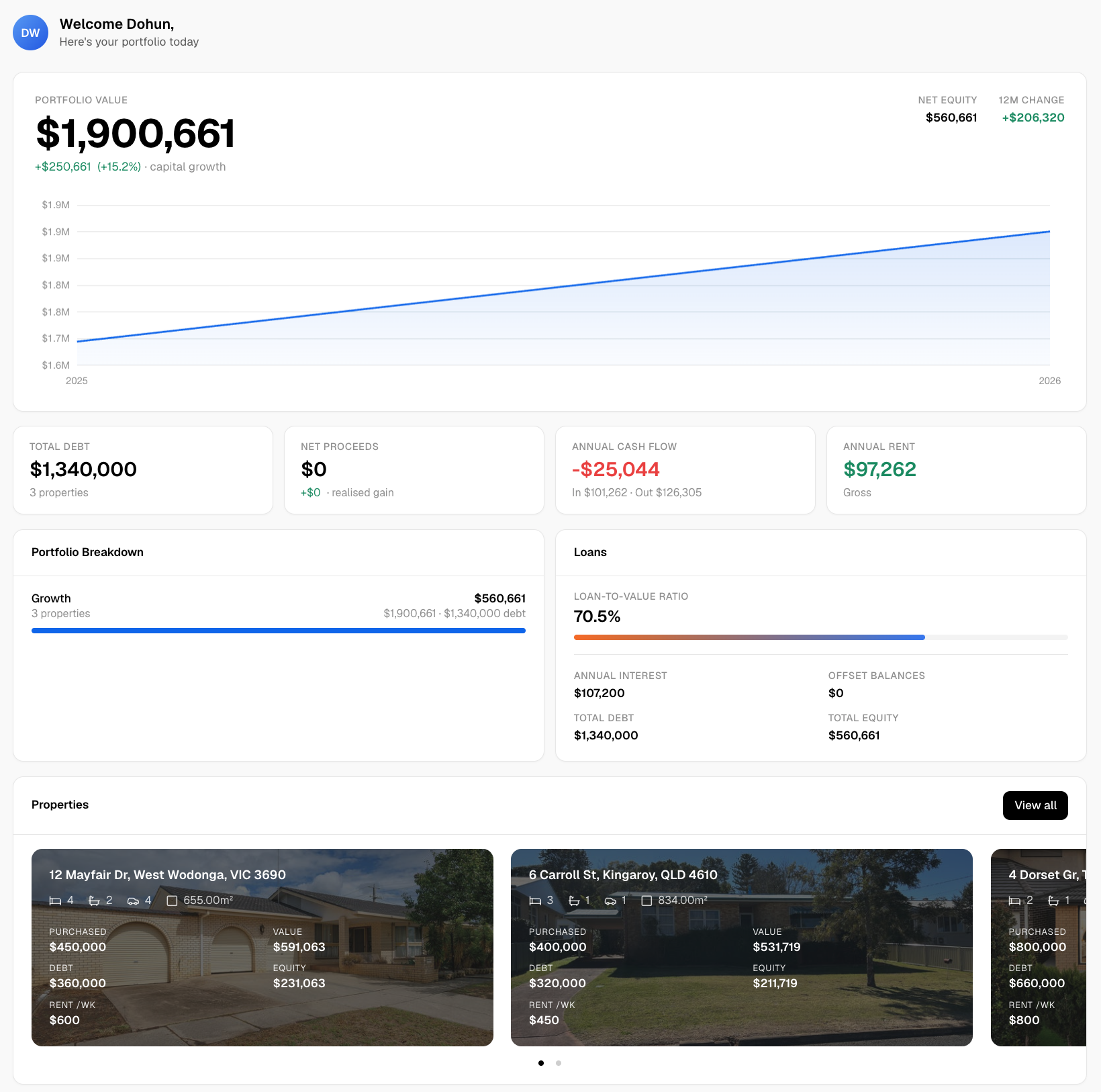
Wealthstacker gives first home buyers the tools to model exactly this kind of decision before committing. Automated quarterly valuations, AI-powered cash flow modelling, and side-by-side comparisons of rentvesting versus buying scenarios mean you go into your first purchase with real numbers, not assumptions. Start modelling your strategy and see what your property wealth could look like over the next decade.