
Buy Now or Wait: Australia’s 90 Day Plan for 2026 Property Decisions
Buy now if your finances are genuinely ready and your target suburb has strong fundamentals. Wait if either one is shaky. That’s the whole decision, stripped of the noise: your deposit, your buffer and your borrowing power on one side, and the specific street or suburb you’re chasing on the other. Government schemes like the 5% Deposit Scheme can tip the answer toward “now” for eligible buyers, even in a softer national market.
TL;DR:
- Waiting is advisable if your deposit, buffer, or borrowing power are weak, especially in suburbs with low demand, oversupply, or poor rental yields.
- Government schemes like the 5% Deposit Scheme and Help to Buy can accelerate buying plans but have strict eligibility criteria that change frequently.
- Preparation within 90 days involves assessing borrowing capacity, narrowing suburbs, locking in professionals, and budgeting for additional purchase costs.
- Market outlook suggests slight national price declines in 2026 with a recovery in 2027, but local conditions heavily influence individual buying decisions.
- Scenario modelling of different deposit sizes, rent versus buy, and timing can help set realistic expectations and reduce guesswork in the decision process.
Table of Contents
- Should I buy now or wait? A decision checklist you can use today
- What does the 2026 market outlook mean for timing?
- How do government grants and schemes change the buying timeline?
- How do I get purchase-ready in 90 days?
- When should you buy now, wait, or go hybrid?
- How does scenario modelling take the guesswork out of buying now or waiting?
- Sources
Should I buy now or wait? A decision checklist you can use today
Run through this list before you look at another listing. Answering “no” to more than one or two points is a strong signal to wait and prepare, not to chase a settlement date.
- Deposit and genuine savings. Do you have the deposit sitting in an account for at least three months, as most lenders require to count it as “genuine savings”?
- Emergency buffer. Can you cover three months of expenses after settlement without touching your deposit?
- Borrowing power under stress. Have you checked what a lender will approve once APRA’s serviceability buffer is applied on top of current rates?
- Pre-approval status. Is that pre-approval current, or has it lapsed and needs resubmitting?
- Income stability. Is a job change, parental leave, or business slowdown likely in the next 12 months?
- Suburb supply. Is property matching your brief actually listing in your target suburb, or are you chasing a market that’s dried up?
- Walk-away price. Have you set a hard ceiling, and do you know how fast you can move if the right property turns up?
Pro Tip: Write your walk-away price down before you inspect anything. Buyers who set it on the spot, mid-auction, almost always move it upward under pressure.
What does the 2026 market outlook mean for timing?

The national picture is soft, not collapsing. KPMG forecasts national house prices will fall slightly in 2026, with a recovery expected through 2027. Units are tracking differently: KPMG expects unit prices to lift by around 2.2% over the same period, a sign that buyers are shifting toward more affordable stock as houses stay stretched.
National figures flatten real differences between cities, though. Sydney and Melbourne have largely stagnated, while Brisbane and Perth recorded stronger growth through early 2026. The API’s Q3 2026 survey backs this up: sentiment is slowing nationally, but Queensland and Western Australia remain notably more optimistic than New South Wales and Victoria.
Rental vacancy rates remain tight, and KPMG’s data points to moderate rental growth, which keeps pressure on tenants and supports the case for buyers weighing rental yield.
That combination, soft prices in some capitals and tight rentals almost everywhere, is exactly why a suburb-by-suburb view of supply and demand matters more than a national headline.
How do government grants and schemes change the buying timeline?
Federal and state support can shrink the gap between “saving” and “buying” by years for the right buyer. Check eligibility carefully before you assume any of these apply to you.
- The Australian Government’s 5% Deposit Scheme lets eligible first-home buyers purchase with a 5% deposit while avoiding Lenders Mortgage Insurance, provided the lender participates and the property sits under the relevant price cap.
- Help to Buy, a shared-equity scheme, opened applications on 5 December 2025 and lets the government co-own a stake in the property, lowering the loan you need. It cannot be combined with the 5% Deposit Scheme, so you need to pick one path.
- The First Home Owner Grant typically pays various cash grants for new homes, depending on the state, alongside separate stamp duty concessions. Rules and caps differ by state, so check your state revenue office before you factor a grant into your budget.
- If you’re comparing timing against a family estate or inheritance situation, it’s worth understanding how costs orders in estate litigation can affect settlement timing and who bears legal costs.
Never assume a scheme applies just because you’ve read about it online. Price caps, income limits, and participating lenders change, and missing one detail can unwind an accepted offer.
How do I get purchase-ready in 90 days?
Preparation, not market timing, is what actually protects buyers from rushed decisions and missed opportunities.
- Days 1 to 30: Get a firm read on your borrowing power, gather payslips, statements and ID, and confirm which grants or schemes you’re eligible for.
- Days 31 to 60: Write a tight property brief (bedrooms, commute, land size), shortlist two or three suburbs, and lock in your broker, conveyancer and building inspector.
- Days 61 to 90: Finalise pre-approval, attend inspections to sharpen your eye for red flags, and set your finance clause period and walk-away price in writing.
Budget for the costs that land at exchange and settlement beyond the deposit: stamp duty (unless a concession applies), LMI if your deposit is under 20% and you’re not using the 5% Deposit Scheme, building and pest inspections, conveyancing fees, and loan establishment costs. These typically add thousands on top of the purchase price, so build them into your numbers early rather than discovering them at contract signing.
Pro Tip: Book your building inspector before you find “the one.” Good inspectors get booked out fast in a tightening market, and a rushed inspection is how buyers miss the costly stuff.
When should you buy now, wait, or go hybrid?
Buy now if you’ve got a three-month buffer, current pre-approval, and your target suburb shows genuine fundamentals: infrastructure spending, diverse employment, and rental yields that hold up under the gross rental yield benchmarks for that area. This applies whether you’re an owner-occupier who needs to buy for life reasons or an investor chasing income in a tight rental market.
Wait and prepare if your buffer is thin, your income is about to change, or you’re eyeing a suburb where buyer research shows fundamentals are weak: job concentration in one industry, oversupply of new stock, or rental yields well below area averages. Waiting six months to fix a shaky deposit beats buying into a suburb with no underlying demand.
Go hybrid if neither path fits cleanly:
- Use shared equity through Help to Buy to buy sooner with a smaller loan.
- Rentvest: rent where you want to live, buy an investment property where the numbers work.
- Buy a smaller first property now as a stepping stone, then trade up once equity and income grow.
The thresholds are simple: a three-month buffer, a deposit that meets your target loan-to-value ratio, and a suburb with rental yield or growth signals that match your goals.
How does scenario modelling take the guesswork out of buying now or waiting?
Good modelling compares outcomes side by side instead of leaving you to guess: projected cashflow, borrowing power under different rate scenarios, rent-versus-buy payoff points, and valuation ranges stretched across 5 to 15 years. Try running two exercises before you decide anything: model a 5% deposit purchase against a 10% deposit purchase to see the LMI and repayment trade-off, then compare a rentvesting scenario against buying where you live.
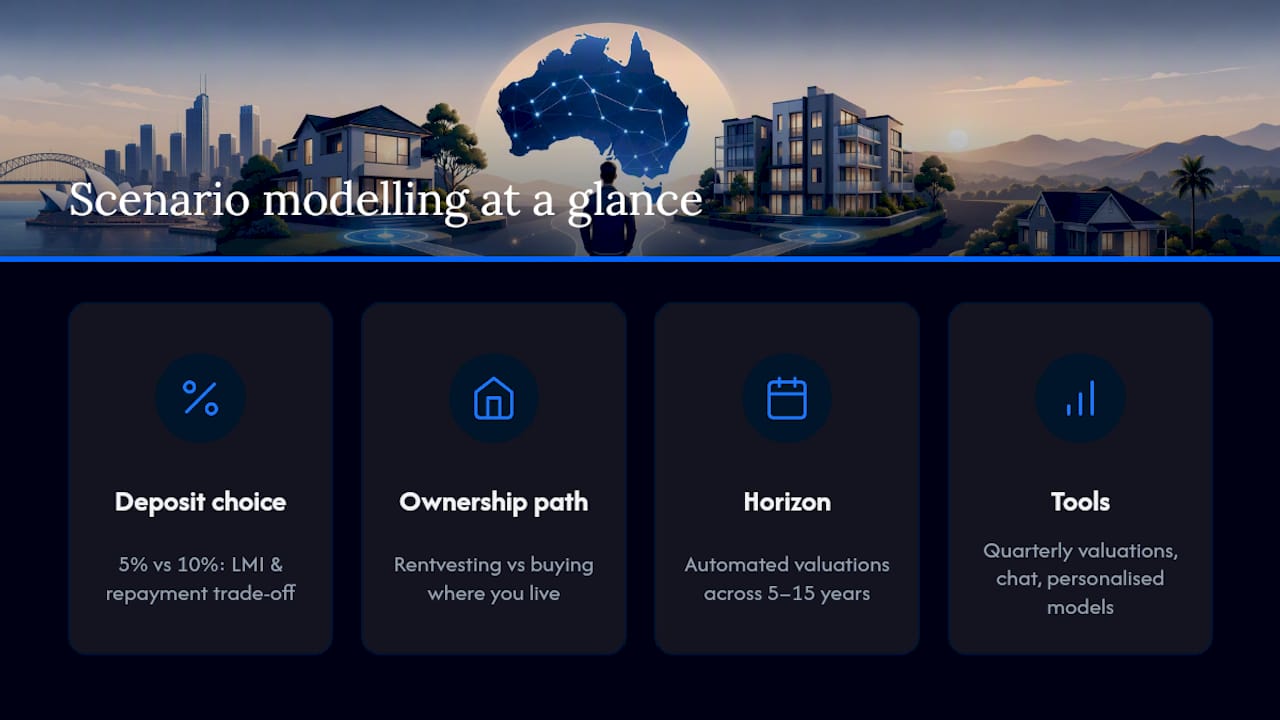
These comparisons use automated quarterly property valuations, chat tools, and personalised modelling for both rentvesting and owner-occupier paths, so you can see a realistic net worth trajectory rather than a gut feeling…
Sources
Verify forecasts against KPMG’s residential outlook and the API’s quarterly property report. Confirm scheme eligibility on the Australian Government’s first-home buyer page and your state revenue office. Wealthstacker’s guides on supply and demand and first-home grants cover the practical detail in more depth.
If you’re ready to stop guessing and see how a 5% versus 10% deposit, or renting versus buying, plays out over the next decade, model your own scenarios with Wealthstacker using its free quarterly valuations and borrowing power tools.
- Rising rates and growing uncertainty continues to cool housing market — KPMG Australia
- Australian Property Market Report Q3 2026 — Australian Property Institute