
What is a property investment trust: a clear guide
TL;DR:
- A property investment trust allows investors to share in managed real estate assets without direct ownership or management responsibilities. These trusts pay out most income as distributions, taxed at the investor’s personal rate, and offer higher liquidity, especially through listed A-REITs. However, they carry risks like market volatility and limited control, making them suitable for diversification and passive income seeking.
A property investment trust is a legal structure where multiple investors pool capital to own and benefit from managed real estate assets, without buying or managing physical properties themselves. The industry standard term for the listed version is a Real Estate Investment Trust, or REIT. In Australia, these are known as A-REITs and trade on the Australian Securities Exchange. Property investment trusts give you access to commercial offices, retail centres, industrial warehouses, and residential portfolios through a single investment. They suit investors who want real estate exposure without the capital, effort, or illiquidity of direct ownership. Understanding how these structures work is the first step toward deciding whether they belong in your portfolio.
What is a property investment trust and how does it work?
A property investment trust is a legal arrangement where a trustee holds real estate assets on behalf of unit holders. The trustee manages the portfolio, collects rental income, and distributes that income to investors according to the number of units they hold. You never own the physical property directly. Instead, you own units in the trust, which entitle you to a share of the income and capital growth.

The mechanics differ from direct ownership in one critical way: the trust, not you, is the legal owner of the properties. This separation creates both benefits and limitations. You gain access to professionally managed assets without taking on landlord responsibilities, but you also give up direct control over which properties the trust buys or sells.
Income distributions are the primary return mechanism. A-REITs must distribute at least 90% of their net taxable income to unit holders. That requirement produces predictable passive income, with index REIT income returns estimated around 5% per annum, plus modest capital growth over the long term.
Tax treatment differs from company investment too. Trusts generally do not pay corporate tax at the trust level. Instead, income passes through to unit holders, who pay tax at their personal marginal rate. This pass-through structure is a defining feature of how a property trust works.
Pro Tip: If you are in a lower tax bracket, the pass-through income from a property trust may be more tax-efficient than dividends from a company, because you pay tax at your personal rate rather than the corporate rate.
- The trustee holds legal title to all properties in the portfolio.
- Unit holders receive income distributions, typically quarterly or half-yearly.
- Capital growth accrues to the value of your units over time.
- Listed trusts allow you to buy or sell units on the ASX during market hours.
- Unlisted trusts lock up your capital for a fixed term, often several years.
What types of property investment trusts exist in Australia?
Three primary categories of property trusts operate in Australia, each with different liquidity profiles, minimum investment thresholds, and risk characteristics.
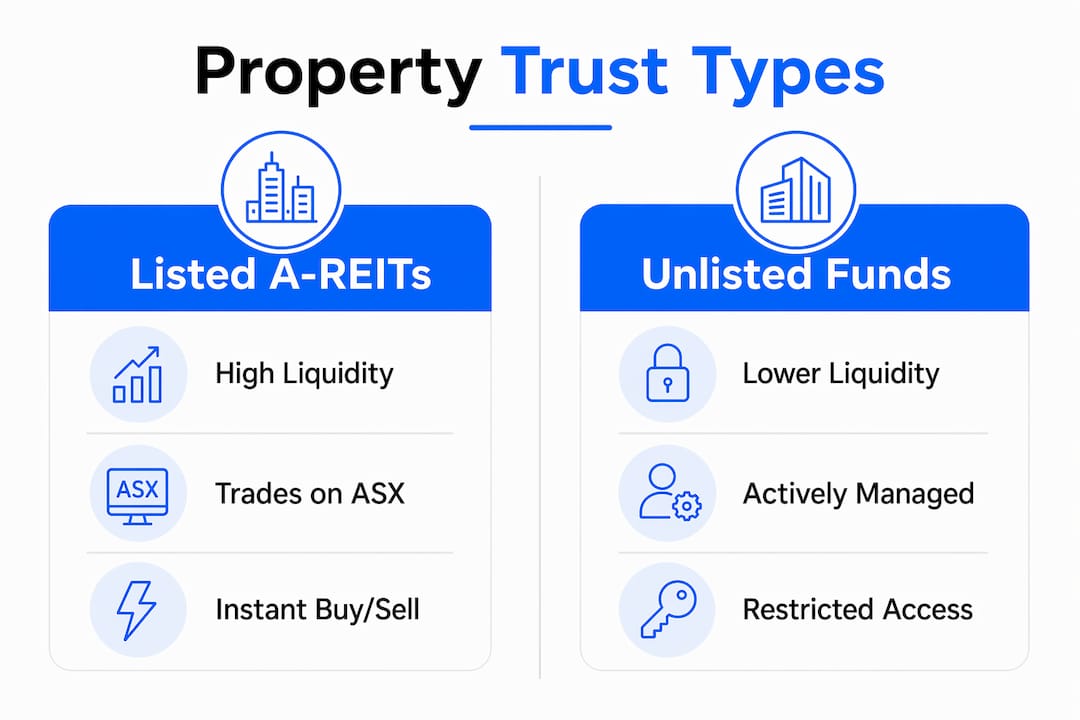
Listed A-REITs
Listed A-REITs trade on the ASX like ordinary shares. You can buy or sell units instantly without the delays and transaction costs of direct property sales. Entry is accessible because you can start with the price of a single unit, avoiding the large capital barriers of direct ownership. A-REITs typically hold diversified portfolios across commercial, retail, or industrial sectors. Many operate as stapled securities, combining a property-owning trust with an operating company, which enables development and management activities but creates more complex tax implications for investors.
Unlisted property funds
Unlisted property funds are not traded on a public exchange. They are actively managed by fund managers who select and operate specific properties. Liquidity is restricted. You generally cannot exit until the fund reaches a redemption window or the fund term ends, which can be five to ten years. Minimum investment amounts are typically higher than for listed trusts. The trade-off is that unlisted funds are insulated from daily share market sentiment, so their unit prices tend to be more stable in the short term.
Property syndicates
Property syndicates pool capital from a small group of investors into a single specific property or a small cluster of properties. They offer a more targeted exposure than diversified funds. Syndicates are generally illiquid and run for a fixed term. They suit investors who want to participate in a specific asset, such as a regional shopping centre or an industrial estate, rather than a broad portfolio. Minimum investment amounts vary but are often substantial.
| Feature | Listed A-REITs | Unlisted funds | Property syndicates |
|---|---|---|---|
| Liquidity | High, daily on ASX | Low, restricted windows | Very low, fixed term |
| Minimum investment | Price of one unit | Typically $10,000+ | Often $50,000+ |
| Diversification | High, broad portfolio | Moderate | Low, single asset focus |
| Price transparency | Daily market price | Periodic valuation | Periodic valuation |
| Management | Professional fund manager | Active fund manager | Syndicate manager |
What are the key benefits of investing through a property trust?
Diversification is the most immediate benefit of a property trust. A single A-REIT unit gives you exposure to dozens of properties across multiple sectors and geographies. Replicating that spread through direct ownership would require millions of dollars and years of acquisition activity. For investors building a property portfolio, trusts provide instant breadth.
Professional management eliminates the day-to-day responsibilities that come with direct ownership. Specialist property teams handle maintenance, tenant disputes, lease negotiations, and compliance. You collect income without fielding calls about broken air conditioning or overdue rent. That reduction in workload is a major draw for investors seeking passive income without operational demands.
Lower entry costs make property trusts accessible to a far wider group of investors. Direct residential property in most Australian capital cities requires a deposit of $100,000 or more, plus stamp duty and legal fees. A listed A-REIT unit can cost as little as a few dollars, making real estate investment available to those still building capital.
Pro Tip: A-REIT distributions are typically unfranked, meaning you receive no franking credits. Factor this into your after-tax return calculations, particularly if you are in a high tax bracket.
- Diversification across property types, sectors, and locations.
- Professional property management with no landlord responsibilities.
- Low minimum investment, especially for listed A-REITs.
- High liquidity for listed trusts, with daily buying and selling on the ASX.
- Predictable income distributions, often quarterly.
- Simplified administration compared to direct property ownership.
What are the risks and drawbacks of property investment trusts?
Property trusts carry real risks that investors must weigh carefully before committing capital. Understanding these drawbacks is as important as recognising the benefits.
-
Market volatility. REIT prices can be more volatile than direct property values because they respond to equity market sentiment and interest rate movements. A rise in interest rates can push A-REIT unit prices down sharply, even when the underlying properties are performing well. Direct property values move more slowly and are less exposed to daily market swings.
-
Loss of control. You have no say in which properties the trust buys, sells, or develops. The fund manager makes all decisions. If the manager pursues a strategy you disagree with, your only option is to sell your units.
-
Unfranked distributions. A-REIT distributions are typically unfranked because the trust generally does not pay corporate tax. This means you receive no franking credits, unlike dividends from many Australian companies. For investors in higher tax brackets, this reduces the after-tax attractiveness of trust income compared to franked dividends.
-
Management fees. Fund managers charge ongoing fees, which reduce your net return. These fees vary across listed and unlisted trusts but are a consistent drag on performance that direct ownership does not impose in the same way.
-
Limited negative gearing benefits. Direct property investors can use negative gearing to offset rental losses against other income. Trust investors generally cannot access this benefit because the trust, not the investor, holds the property and bears the costs.
-
Stapled security complexity. Many A-REITs operate as stapled securities, which can affect income distributions and create complex tax positions. Understanding the tax implications of a stapled structure requires careful review, and in some cases, professional advice.
How do property investment trusts compare with direct property ownership?
The choice between a property trust and direct ownership comes down to your goals, tax position, and appetite for control. Neither option is universally superior. Each suits a different investor profile.
Direct residential property often outperforms REITs over the long term through leverage and capital growth, but trusts offer better liquidity and lower entry costs. A leveraged direct property purchase amplifies both gains and losses. A trust investment is generally unleveraged at the investor level, which limits downside but also caps the upside that leverage provides.
| Factor | Property investment trust | Direct property ownership |
|---|---|---|
| Liquidity | High (listed) to low (unlisted) | Low, months to sell |
| Entry cost | Low to moderate | High, deposit plus stamp duty |
| Control | None, manager decides | Full control |
| Negative gearing | Not available to investor | Available |
| CGT discount | Passed through by trust | Available after 12 months |
| Management burden | None | Significant |
| Income predictability | High, regular distributions | Variable, vacancy risk |
Tax treatment is a key differentiator. Direct property investors can negatively gear losses against other income and access the 50% capital gains tax discount after holding for 12 months. Trust investors receive distributions that are taxed at their marginal rate, with no franking credits and limited ability to offset losses. Investors should align their choice with their tax bracket and asset protection goals, balancing passive income simplicity against the tax advantages of direct ownership.
For investors who want exposure to property without the capital, time, or expertise required for direct ownership, a trust is a practical starting point. For those who can service a mortgage and want maximum control and tax flexibility, direct ownership may deliver stronger long-term outcomes. Many investors hold both, using trusts for liquidity and diversification while building a direct property portfolio over time. Exploring property investment strategies in detail helps clarify which mix suits your situation.
Key takeaways
A property investment trust gives investors real estate exposure through pooled ownership, with the structure, trust type, and tax position determining whether it suits your goals.
| Point | Details |
|---|---|
| Core structure | A trustee holds property assets and distributes income to unit holders based on units owned. |
| Three trust types | Listed A-REITs, unlisted property funds, and syndicates each offer different liquidity and access. |
| Income requirement | A-REITs must distribute at least 90% of net taxable income, producing predictable returns. |
| Key risk | REIT prices are more volatile than direct property due to equity market and interest rate sensitivity. |
| Tax consideration | A-REIT distributions are typically unfranked, which reduces after-tax returns for high-bracket investors. |
Wealthstacker makes property trust investing clearer
Deciding between a property trust and direct ownership requires real numbers, not guesswork. Wealthstacker gives you the tools to model both paths side by side, with automated quarterly valuations and AI-powered forecasting built in.

Whether you are weighing an A-REIT against a direct purchase or trying to understand how a trust fits into your broader investment plan, Wealthstacker maps your projected net worth across both scenarios in real time. You can assess borrowing power, compare rentvesting and buying strategies, and track portfolio performance without paying for a financial adviser every time your situation changes. Start building a clearer picture of your property future with the Wealthstacker portfolio tracker.
FAQ
What is a property investment trust in simple terms?
A property investment trust is a structure where investors pool money to own a share of managed real estate assets. You receive income distributions without buying or managing a property directly.
How does a property trust work for income?
The trust collects rental income from its properties and distributes at least 90% of net taxable income to unit holders. Distributions are typically paid quarterly or half-yearly.
Are A-REIT distributions taxed in Australia?
Yes. A-REIT distributions are taxed at your personal marginal rate and are typically unfranked, meaning you receive no franking credits to offset your tax liability.
What is the difference between a listed and unlisted property trust?
Listed A-REITs trade on the ASX and offer daily liquidity. Unlisted property funds are not publicly traded, restrict access to your capital, and typically require a higher minimum investment.
Can I use negative gearing with a property investment trust?
No. Negative gearing applies to direct property ownership where you personally hold the asset and bear the costs. Trust investors cannot offset trust-level losses against their personal income.