
Rentvesting strategy explained: a practical guide for renters
TL;DR:
- Rentvesting allows Australians to invest in properties with strong potential while renting in preferred suburbs.
- Success depends on careful cashflow modelling, adequate buffers, and understanding tax and market risks.
Rentvesting is buying an investment property where the numbers stack up while renting the home you actually want to live in. You own in an affordable or high-growth market; you live wherever suits your life. It’s a genuine path into property ownership for Australians priced out of their preferred suburb, but it only works if the cashflow holds up under pressure.
Who tends to benefit: renters with stable income, strong borrowing power, a long-term horizon, and no immediate need for first home buyer grants.

Who should probably look elsewhere: first home buyers relying on state stamp duty concessions, anyone with a thin financial buffer, or people who need the security of owning their own home.
Quick snapshot:
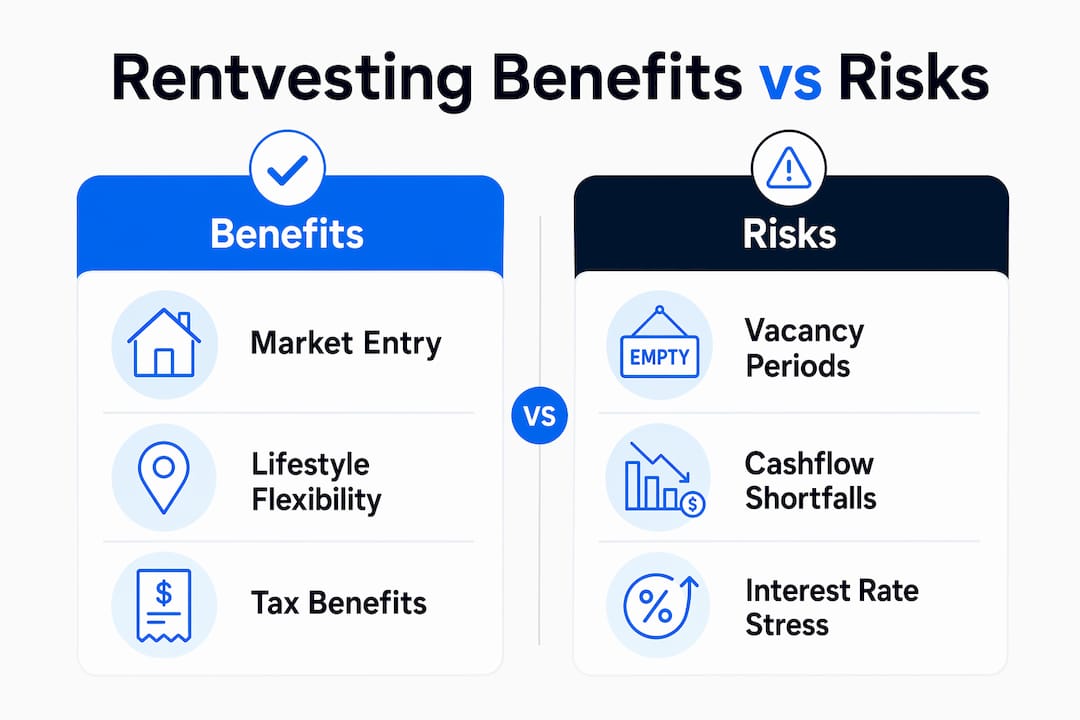
- Pros: earlier market entry, live where you want, potential tax deductions, geographic flexibility
- Cons: dual housing costs, negative cashflow risk, vacancy exposure, forfeited first home benefits
Before you go further, run a cashflow model or speak to a mortgage broker and accountant. The numbers either work or they don’t, and no amount of enthusiasm changes that.
Table of Contents
- What is the rentvesting strategy and how does it work in practice?
- What are the real benefits of rentvesting?
- What are the downsides and risks of rentvesting?
- Australian tax and financing rules that change the rentvesting equation
- Is rentvesting right for you? A decision checklist
- How to start rentvesting: a practical step-by-step checklist
- Worked example: modelling three rentvesting scenarios
- Key takeaways
- Model your rentvesting scenarios with Wealthstacker
- Useful sources and tools
What is the rentvesting strategy and how does it work in practice?
The mechanics are straightforward, but the details matter. Here’s the typical sequence from decision to ongoing management.
- Assess your finances. Calculate your deposit (typically a portion of the purchase price as advised by your financial advisor), your current rent as an ongoing liability, and how much monthly shortfall you can absorb if the property sits vacant.
- Research investment markets. You’re not buying where you live. Look for suburbs with strong rental demand, population growth, and a gross yield that covers a meaningful portion of your mortgage. Rental yield vs capital growth are the two levers you’re pulling simultaneously.
- Get pre-approval for an investment loan. Investment loans differ from owner-occupier loans in two important ways. First, lenders typically count only 75–80% of projected rental income for serviceability purposes. Second, investment loan rates are often priced 0.25–0.40% higher than equivalent owner-occupier rates. Both reduce your borrowing power compared to what you might expect.
- Make an offer and settle. Standard conveyancing applies. Budget for stamp duty, legal fees, building and pest inspections, and lender’s mortgage insurance if your deposit is below 20%.
- Place a tenant and appoint a property manager. A good property manager handles lease agreements, rent collection, maintenance coordination, and compliance. Their fees typically run 6–10% of rent collected, plus letting fees for new tenancies.
- Manage ongoing cashflow. Every month, your rental income offsets the mortgage. The gap between income and total costs is your shortfall, which you cover from your own pocket.
Typical ongoing costs to include in every model:
- Mortgage interest (principal repayments don’t reduce taxable income)
- Property management fees (6–10% of rent)
- Repairs and maintenance
- Landlord insurance
- Council rates and water rates
- Strata levies (for units and townhouses)
- Vacancy buffer (periods with no tenant)
- Accounting fees
Pro Tip: Budget for a 3–6 month vacancy and repairs buffer before you buy, and stress-test your model at interest rates 2–3% above your current rate. If the numbers break at that point and you have no buffer, the property is too expensive for your situation.

What are the real benefits of rentvesting?
The appeal is genuine, but each benefit comes with conditions. Here’s what actually materialises and when.
-
Earlier market entry. Buying in an affordable market now means you start building equity sooner rather than waiting years to save a deposit for a property in your preferred suburb. For many Australians priced out of inner-city markets, this is the single most compelling reason to consider the strategy. The equity you accumulate can later be used as a deposit on a home you actually want to live in.
-
Live where your life is. You rent in the suburb that suits your commute, social life, or school catchment, without being locked into a location purely because it’s what you could afford to buy. That flexibility has real value, particularly for professionals whose careers might move them interstate.
-
Geographic diversification. Your investment doesn’t have to sit in the same market as your lifestyle. You can target an emerging regional city or interstate suburb with stronger yield and growth prospects than anything available near your workplace. Building a property portfolio while renting is a genuine long-term wealth strategy when the underlying assets are chosen well.
-
Potential tax deductions. Interest, management fees, repairs, depreciation, and other holding costs are generally deductible against rental income. If the property is negatively geared, the net loss may offset other taxable income. This benefit is conditional. Tax rules changed materially in May 2026 (covered below), and investment decisions should always consider comprehensive risk disclosure; deductions should be modelled conservatively, not treated as the reason to buy.
-
Forced savings discipline. Owning an investment property creates a structured commitment to building wealth. Unlike a share portfolio you can liquidate on a bad day, property requires a long-term mindset by default.
The benefits that are most reliable are market entry and lifestyle flexibility. Tax benefits are real but secondary, and capital growth depends entirely on where and what you buy.
What are the downsides and risks of rentvesting?
Rentvesting carries risks that are easy to underestimate when you’re focused on the upside. Here are the ones that actually derail people.
-
Dual housing costs. You’re paying rent and covering any mortgage shortfall simultaneously. In a high-rate environment, that shortfall can be substantial, and it comes out of your take-home pay every month regardless of what the property is worth on paper.
-
Vacancy risk. A vacant property earns nothing but still costs you interest, insurance, and rates. Even a four-week vacancy in a year materially changes your annual cashflow. Budget for it explicitly rather than hoping it won’t happen.
-
Property management headaches. You’re a landlord. Tenants leave, hot water systems fail, and disputes happen. A professional property manager reduces the burden but doesn’t eliminate it, and their fees reduce your net yield.
-
Forfeited first home buyer benefits. Buying an investment property first typically means losing access to the First Home Owner Grant and state stamp duty concessions, which require owner-occupation within a set timeframe. In some states, that’s tens of thousands of dollars in foregone concessions. Model the lost benefit against expected capital growth before deciding.
-
Higher investment loan rates. The 0.25–0.40% rate premium on investment loans is a recurring cost over the life of the loan. On a $600,000 mortgage, that’s roughly $1,500–$2,400 per year in additional interest.
-
Tax rule changes. The May 2026 federal budget restricted negative gearing on established property purchases made after 12 May 2026, with new builds treated more favourably under transitional rules. Decisions based on the pre-2026 tax settings may not hold up.
-
Geographic mismatch. Managing a property interstate or in a regional area you don’t know well adds complexity. Vacancy rates, tenant quality, and local market dynamics are harder to monitor from a distance.
Cashflow volatility is the single biggest practical threat to rentvesting success. The strategy doesn’t fail because the property didn’t grow — it fails because the investor ran out of cash to hold it. A 3–6 month vacancy buffer and a stress-tested interest rate model aren’t optional extras; they’re the floor.
Red flags to watch before buying:
- Gross yield below 4% in a market with modest growth prospects
- High loan-to-value ratio with no cash buffer beyond the deposit
- Reliance on tax deductions to make the numbers work
- Weak local rental demand or high advertised vacancy rates
- A purchase price that only makes sense with optimistic growth assumptions
Australian tax and financing rules that change the rentvesting equation
Tax and lending rules don’t just affect your returns at the margin. In some cases they determine whether the strategy is viable at all.
Negative gearing and the May 2026 changes
Negative gearing allows you to offset a net rental loss against your other taxable income, reducing your tax bill. For established properties purchased after 12 May 2026, proposed federal changes restrict this treatment. New builds retain more favourable treatment under the transitional rules. If you’re considering an established property, get current advice on how the rules apply to your specific purchase date and structure.
Capital gains tax (CGT) applies when you sell. The 50% CGT discount for assets held longer than 12 months still applies for individuals, but the interaction with the new negative gearing rules and your overall tax position needs professional modelling.
Commonly deductible investment costs (check with your accountant):
- Loan interest
- Property management fees
- Repairs and maintenance (not capital improvements)
- Depreciation on plant and equipment
- Landlord insurance
- Council and water rates
- Accounting fees related to the investment
The ATO’s residential rental property guidance is the authoritative source for what’s deductible and what’s capital in nature. Read it before you model.
How lenders treat rental income
Lenders don’t count 100% of your projected rent. Most shade it to 75–80% of gross rental income for serviceability calculations, and they apply their own interest rate buffer on top of the actual rate. That combination reduces your assessed borrowing power compared to what a simple calculation suggests. Get the lender’s assumptions in writing before you rely on a pre-approval figure.
Pro Tip: Model the investment with all tax benefits removed. If the property still produces a manageable cashflow shortfall on pure rental income versus costs, you have a sound base case. If it only works because of deductions, you’re one policy change away from a problem.
Is rentvesting right for you? A decision checklist
Rentvesting suits a specific profile. Run through these honestly before you go further.
Consider rentvesting if:
- You have stable employment income and a deposit of at least 10–20%
- You can absorb 3–6 months of mortgage costs without rental income
- You’re comfortable renting long-term and don’t need to own your home for security
- You’re in a higher marginal tax bracket and can benefit from deductions (with the post-2026 caveats)
- Your target lifestyle suburb is significantly more expensive than viable investment markets
- You have a holding horizon of at least 7–10 years
Think carefully before proceeding if:
- You’re relying on the First Home Owner Grant or stamp duty concessions to make your purchase viable — buying as an investor first forfeits those benefits
- Your financial buffer is thin; a single vacancy or rate rise would cause genuine hardship
- You need the stability of owning your own home for personal or family reasons
- You’re buying primarily for tax benefits rather than yield and growth
Questions to bring to your broker:
- What borrowing power do I have for an investment loan, including my current rent as a liability?
- What rental income shading percentage does your lender apply?
- What is the interest rate differential between investment and owner-occupier loans on your panel?
- At what LVR does LMI apply, and what does it cost for my target purchase price?
Questions to bring to your accountant:
- How do the May 2026 negative gearing changes apply to my target property type and purchase date?
- What is my effective marginal tax rate, and how much does negative gearing actually save me annually?
- Have I modelled the value of forfeited first home concessions against projected capital growth?
For a direct comparison of the two paths, rentvesting vs buying your first property lays out the trade-offs side by side.
How to start rentvesting: a practical step-by-step checklist
- Audit your finances. Calculate your net monthly income, current rent, savings rate, and existing debts. Know your deposit amount and how long your buffer will last if the investment property sits vacant.
- Get a written borrowing power assessment. Use a mortgage broker, not just an online calculator. Ask them to include your current rent as a liability and to show you the rental income shading they’ve applied. Get the lender’s serviceability assumptions in writing.
- Set a vacancy and repairs buffer. Before you commit to a purchase price, confirm you can hold the property for 3–6 months with zero rental income. This is non-negotiable.
- Research investment markets by yield and fundamentals. Target areas with strong rental demand, low vacancy rates, infrastructure investment, and population growth. Cheapest isn’t best. Use rental yield metrics as a filter, not a final answer.
- Choose a property type suited to your budget and market. Houses in outer suburbs often deliver stronger land value growth; units in high-demand areas can deliver stronger yield. Match the type to the market’s fundamentals.
- Seek formal pre-approval. A pre-approval letter gives you negotiating credibility and confirms the lender’s actual serviceability assessment for your specific situation.
- Appoint a property manager before settlement. A good manager should have the property listed for rent before you settle. Ask about their vacancy rate, average days to lease, and fee structure.
- Final checks with your accountant and solicitor. Confirm the tax treatment of your purchase, review the contract, and verify stamp duty and any applicable concessions or surcharges.
Tools to use at each step:
- Rental yield calculators (gross and net)
- Serviceability calculators from your lender or broker
- Wealthstacker’s scenario modelling for cashflow and net worth projections
- ATO’s rental property deduction guides
Pro Tip: Ask your lender to provide in writing: the rental income percentage they’ve used, the interest rate stress test applied, and the LVR at which LMI triggers. Verbal assurances at pre-approval don’t always survive to formal approval.
Worked example: modelling three rentvesting scenarios
A worked example makes the abstract concrete. The figures below are illustrative, not a prediction or financial advice.
Base scenario assumptions
| Item | Amount |
|---|---|
| Monthly shortfall | ~$723 |
At $723 per month out of pocket, the question is whether capital growth over 7–10 years justifies that cost. That depends entirely on the market.
Three-scenario comparison (7-year horizon)
| Scenario | Annual growth assumption | Vacancy assumption | Approx. equity gain (7 yrs) | Verdict |
|---|---|---|---|---|
| Pessimistic | 2% p.a. | 6 weeks/year | — | Marginal; cashflow drag may not be worth it |
| Base | 4% p.a. | 3 weeks/year | — | Viable if buffer is in place |
| Optimistic | 6% p.a. | 1 week/year | — | Strong, but don’t plan around it |
The pessimistic scenario uses a conservative 3–4% growth assumption recommended by finance professionals when stress-testing. The optimistic scenario is possible in high-demand markets but shouldn’t be the base case.
For a deeper breakdown of how yield and growth interact over time, gross rental yield explained walks through the formulas in detail.
Recommended modelling tools:
- Gross and net rental yield calculators
- Borrowing power calculators (use your broker’s lender-specific version)
- Cashflow scenario modellers (Wealthstacker’s platform runs pessimistic/base/optimistic scenarios automatically)
- ATO’s depreciation and deduction guides for investment properties
Pro Tip: Always run the worst-case scenario first. If the pessimistic numbers would cause you genuine financial stress, the property is too expensive or your buffer is too thin. Comfort with the downside is what lets you hold through a flat market.
Key takeaways
Rentvesting works when cashflow is modelled conservatively, tax benefits are treated as secondary, and the investor has a genuine buffer to absorb vacancy and rate rises.
| Point | Details |
|---|---|
| Cashflow first | Model the shortfall without tax benefits; if it’s unmanageable, the property doesn’t stack up. |
| Tax is a bonus, not the base case | Post-May 2026 rule changes mean established property buyers can’t rely on negative gearing as before. |
| Vacancy and rate buffers are mandatory | Budget for 3–6 months of costs with no rental income and stress-test at rates 2–3% higher. |
| First home benefits may be forfeited | Buying as an investor first typically disqualifies you from the First Home Owner Grant and stamp duty concessions. |
| Wealthstacker for scenario modelling | Run pessimistic, base, and optimistic cashflow scenarios on Wealthstacker before committing to a purchase. |
Model your rentvesting scenarios with Wealthstacker
Most people spend more time researching a laptop than they do stress-testing a $500,000 property decision. Wealthstacker is built for exactly the modelling work this article describes: automated quarterly valuations, real-time net worth projections, and side-by-side scenario comparisons for rentvesting versus buying.
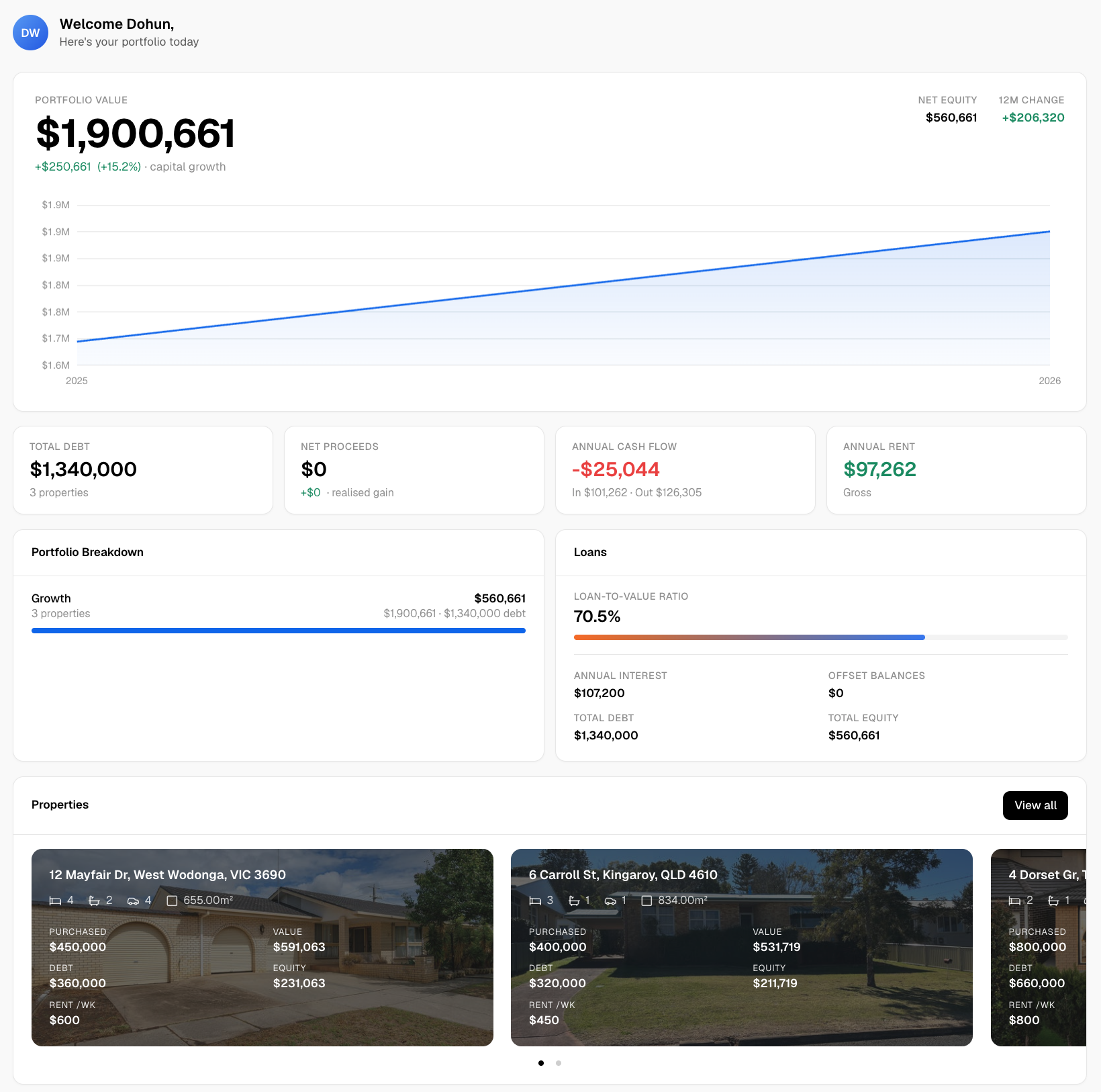
You can run a pessimistic, base, and optimistic cashflow model before you speak to a broker, so you walk into that conversation knowing your numbers. Wealthstacker’s AI-assisted tools let you adjust growth assumptions, vacancy rates, and interest rate scenarios in real time, giving you a clear picture of what each outcome means for your net worth over 5, 10, or 15 years. There’s no obligation and no subscription required to get started.
Run your rentvesting model on Wealthstacker and see whether the numbers work for your situation. This article is general information only. Speak to a licensed mortgage broker, accountant, and solicitor before making any property investment decision.
Useful sources and tools
The following Australian sources are authoritative starting points for current rules, calculators, and guidance. Check publication dates and confirm details apply to your state and purchase structure.
- ATO — Residential rental properties: The definitive guide to deductible expenses, depreciation, and record-keeping requirements for investment property owners.
- ATO — CGT when selling your rental property: Explains how capital gains tax applies on sale, including the 12-month discount and cost base calculations.
- Treasury — negative gearing review: Background on the policy rationale and historical treatment of negative gearing in Australia.
- firsthome.gov.au: Official information on the First Home Owner Grant and eligibility requirements by state and territory.
- DHA — rentvesting as a modern approach: Defence Housing Australia’s investor-focused overview of the rentvesting model.
- NAB — rentvesting pros and cons: Practical lender perspective on costs, risks, and considerations for prospective rentvestors.
This article covers Australian rules and market conditions. Tax legislation and state-based concessions change; always verify current rules with the ATO, your state revenue office, and a qualified professional before making a decision.