
What is portfolio rebalancing property: 2026 guide
TL;DR:
- Property rebalancing involves deliberately adjusting real estate holdings to maintain target asset allocation and manage risk. It emphasizes refining the portfolio for long-term resilience rather than just acquiring more properties. Effective strategies include setting asset targets, managing concentration risk, and regularly reviewing loan structures and cash buffers.
Portfolio rebalancing property is defined as the deliberate realignment of your real estate holdings to restore your target asset mix, manage risk, and support long-term wealth growth. The industry term for this process is property asset allocation rebalancing, and it applies whenever your portfolio drifts from its intended balance of growth assets and income assets. In 2026, with Australian interest rates and lender policies shifting, this discipline separates investors who build durable portfolios from those who accumulate properties without a plan.
What is a property portfolio rebalancing strategy?
A property portfolio rebalancing strategy is a structured plan for adjusting your real estate holdings to keep your asset mix, risk exposure, and cash flow aligned with your financial goals. It is not simply a plan to buy more properties. Experienced investors treat rebalancing as portfolio refinement, focused on improving bankability and long-term resilience rather than growing a headcount of assets.
The two core building blocks of any rebalancing strategy are “Growth Engines” and “Cash Flow Anchors.” Growth Engines are capital appreciation assets, typically blue-chip residential properties in high-demand locations. Cash Flow Anchors are higher-yield assets that generate rental income to service debt and fund holding costs. Blue-chip assets typically yield 3%–4% in rental income, which means they rarely cover their own costs without complementary high-yield properties in the mix. A well-structured strategy balances both.
A rebalancing strategy also defines when and how you act. Systematic rebalancing sets clear triggers, such as a property’s value drifting more than a set percentage from its target weighting, or a cash flow ratio falling below a defined threshold. Reactive rebalancing, by contrast, responds to market noise or emotion. Systematic approaches consistently outperform reactive ones because they remove guesswork from high-stakes decisions.
Key elements every strategy should address:
- Asset mix targets: Define the ratio of growth to income properties you want to hold.
- Risk tolerance: Set the maximum concentration in any single location, lender, or property type.
- Investment goals: Specify whether you are building for capital growth, passive income, or both.
- Review schedule: Commit to a formal portfolio audit at least once per year.
- Disposal criteria: Decide in advance which conditions would trigger a sale or refinance.
Pro Tip: Write your rebalancing strategy down as a one-page investment policy. A written policy prevents emotional decisions during market downturns and gives you a clear benchmark to measure performance against.
Why is portfolio rebalancing critical for risk management?
Concentration risk is the most underrated danger in a multi-property portfolio. It occurs when too much of your wealth depends on one bank, one city, or one asset type. Portfolios with three or more properties face this risk acutely, even when the properties appear diverse on the surface. A single localised downturn, a lender policy change, or a vacancy cluster can destabilise the entire portfolio.
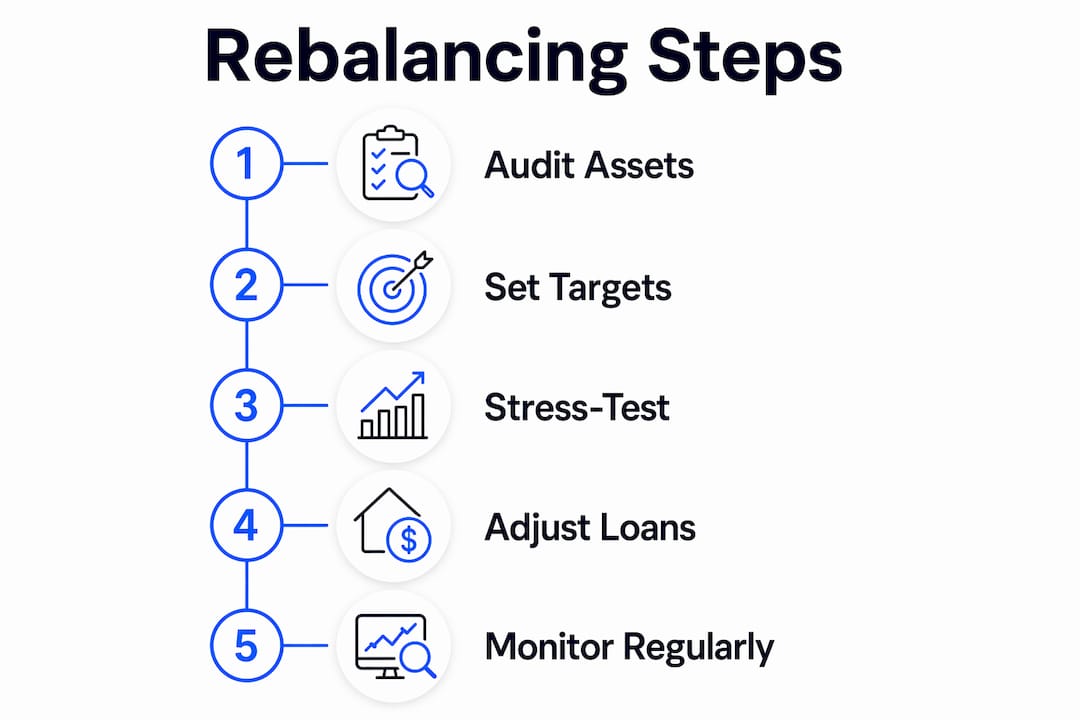
Interest rate fluctuations compound this risk. When rates rise, debt serviceability tightens and lenders reassess borrowing capacity. Best-practice risk management in 2026 requires stress-testing debt serviceability at higher interest rates and targeting interest coverage ratios of at least 2x on base case rents. That ratio acts as a buffer. If your rental income only just covers your repayments at current rates, any rate increase or vacancy period puts you at risk of a forced sale.
Cash flow buffers are a non-negotiable part of risk management. Maintaining a cash reserve equivalent to 6–12 months of property expenses protects the portfolio during vacancies or rate shocks. This buffer prevents the forced deleveraging that destroys long-term returns.
Tax and transaction costs deserve equal attention. Rebalancing triggers capital gains tax events and incurs stamp duty, agent fees, and legal costs. Ignoring tax drag can erode returns considerably, particularly when selling properties held for less than 12 months. Every disposal decision must be modelled for its net benefit after friction costs.
Rebalancing a property portfolio is not just about what you buy or sell. It is about whether your overall structure can survive a rate shock, a vacancy, or a lender policy change without forcing your hand. The investors who avoid distress sales are the ones who planned for stress before it arrived.
Geographic diversification is one of the most effective tools for reducing concentration risk. Owning properties across multiple states reduces exposure to localised market shocks and can significantly lower annual land tax liabilities, since each state applies its own thresholds. This is a structural advantage that pure single-market investors cannot access. For a deeper look at how diversification reduces concentration risk, the mechanics are worth understanding before you act.
How to rebalance your property portfolio effectively in 2026
Effective rebalancing starts with an honest audit of what you already hold. Map every property’s current value, rental yield, loan structure, and vacancy history. Identify which assets are performing and which are dragging on serviceability. This audit gives you the baseline for every decision that follows.

From that baseline, set a portfolio blueprint. Your blueprint defines the diversification targets across locations, property types, and income profiles that you want to reach. It also identifies the gaps between where you are now and where you want to be. Without a blueprint, rebalancing becomes guesswork dressed up as strategy.
Loan structuring is where most investors lose ground. Cross-collateralisation across multiple properties traps serviceability and limits refinancing options. Separating securities so that each property carries its own financing preserves borrowing capacity and gives you flexibility to act when opportunities arise. This structural discipline is what separates investors who can keep growing from those who hit a wall.
Practical steps for executing a rebalance in 2026:
- Audit loan structures first: Identify any cross-collateralised loans and work with a broker to separate them before making new acquisitions.
- Sequence disposals before acquisitions: Selling an underperforming asset before buying a replacement avoids serviceability pressure and gives you a cleaner balance sheet.
- Model tax before you act: Run a capital gains tax estimate on any planned sale. If the tax cost outweighs the benefit of rebalancing, consider holding and adjusting cash flow through refinancing instead.
- Adjust cash buffers: After any acquisition or disposal, recalculate your cash reserve to confirm it still covers 6–12 months of expenses across the whole portfolio.
- Use market data for timing: Review vacancy rates, median price trends, and rental yield movements in your target markets before committing to a new purchase.
Pro Tip: Use investment property forecasting tools to stress-test your portfolio at interest rates 2% above current levels before finalising any rebalancing move. If the numbers do not work under stress, the move is not ready.
Rebalancing also means adjusting loan terms and cash buffers, not just buying or selling assets. Refinancing an existing loan to a lower rate, switching from interest-only to principal and interest, or releasing equity to fund a cash buffer are all legitimate rebalancing moves. The goal is a well-structured property portfolio that can grow without becoming fragile.
Common mistakes property investors make when rebalancing
The most common misconception is that rebalancing means buying more properties. Accumulation and rebalancing are different disciplines. Accumulation grows the portfolio. Rebalancing improves its structure, risk profile, and cash flow health. Conflating the two leads investors to keep buying when they should be refinancing, consolidating, or selling.
Common mistakes to avoid:
- Ignoring serviceability limits: Adding a new property without checking whether your existing loan structure can absorb the additional debt is the fastest way to hit a borrowing wall.
- Chasing popular postcodes: Reactive buying based on popular postcodes often results in costly mistakes. Paying a premium for a “hot” suburb locks in low yields and high entry costs that take years to recover.
- Skipping the tax calculation: Selling a property without modelling the capital gains tax outcome is a costly oversight. Tax drag from selling investment properties can outweigh the short-term benefit of realigning the portfolio.
- Neglecting a written investment policy: Systematic investment policies that guide acquisitions and disposals prevent emotional reactions that disrupt portfolio stability. Without one, every market movement becomes a potential trigger for a poor decision.
- Overlooking lender concentration: Using the same bank for every property in the portfolio creates a single point of failure. If that lender tightens its criteria or reassesses your portfolio, your entire borrowing capacity can be affected at once.
The investors who build durable portfolios treat every rebalancing decision as a business decision. They model the numbers, check the structure, and act on a plan rather than a feeling. For guidance on property investment reporting that supports systematic decisions, a written framework makes the difference between discipline and drift.
Key takeaways
Property portfolio rebalancing is the structured process of adjusting your real estate holdings, loan structures, and cash buffers to maintain your target asset mix, manage concentration risk, and protect long-term returns.
| Point | Details |
|---|---|
| Define your asset mix | Set clear targets for growth versus income properties before making any rebalancing move. |
| Stress-test serviceability | Target interest coverage ratios of at least 2x on base case rents to withstand rate shocks. |
| Maintain a cash buffer | Hold 6–12 months of property expenses in reserve to avoid forced sales during vacancies. |
| Model tax before selling | Calculate capital gains tax and transaction costs before any disposal to confirm the net benefit. |
| Separate loan securities | Avoid cross-collateralisation so each property carries its own financing and preserves borrowing capacity. |
How Wealthstacker supports your rebalancing decisions
Knowing what to rebalance is only half the challenge. Acting on accurate, up-to-date data is the other half.
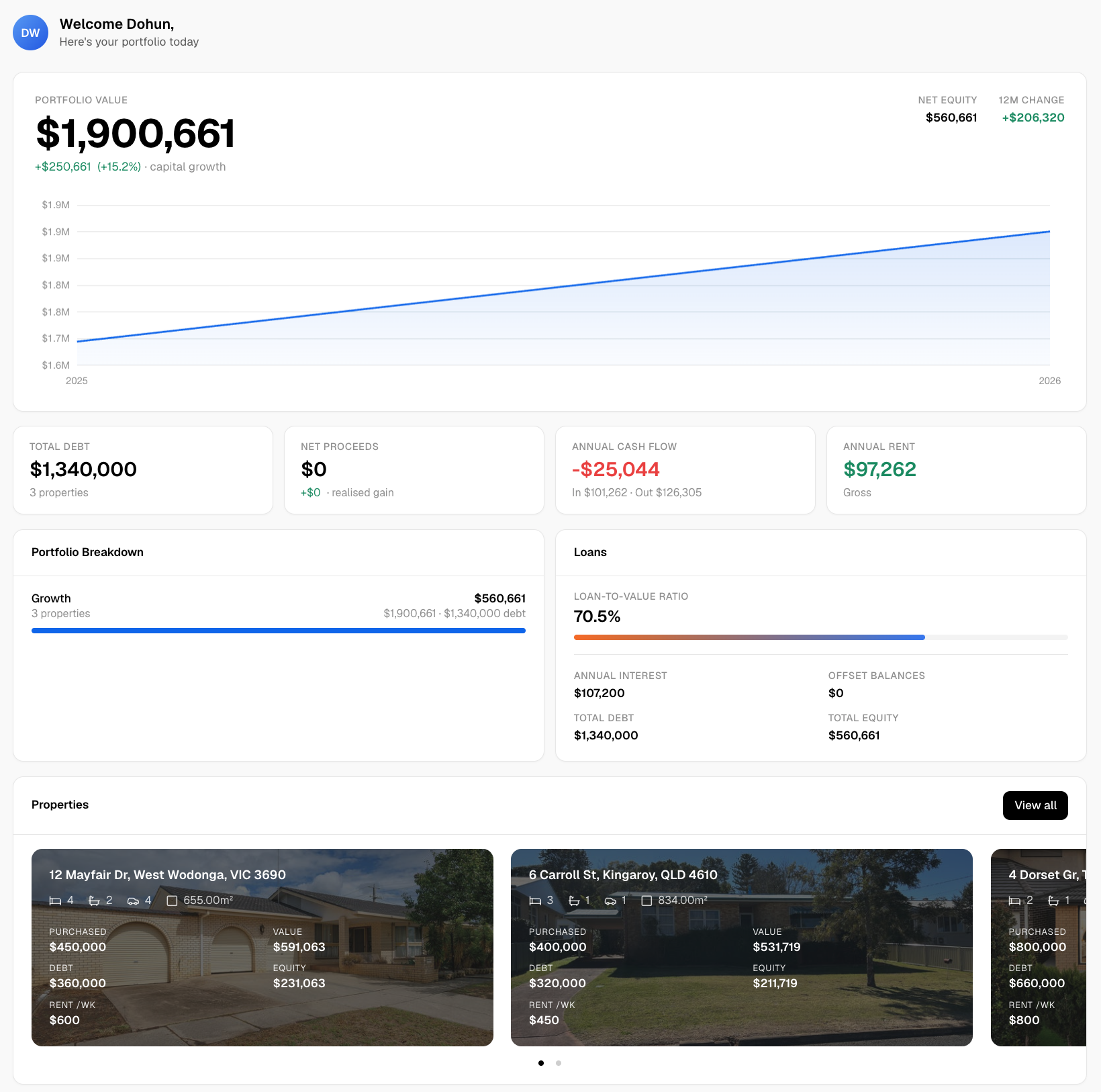
Wealthstacker gives property investors the tools to track portfolio performance, model wealth accumulation scenarios, and assess borrowing capacity in real time. The platform provides automated quarterly valuations at no cost, so your portfolio data stays current without manual research. Its AI-driven modelling covers both rentvesting and direct ownership strategies, letting you compare paths and see the financial impact of each rebalancing decision before you commit. Whether you are assessing a potential acquisition or deciding whether to sell an underperforming asset, the Wealthstacker portfolio tracker gives you the numbers you need to act with confidence rather than guesswork.
FAQ
What is portfolio rebalancing in property investment?
Portfolio rebalancing in property investment is the process of adjusting your real estate holdings to restore your target asset mix, manage risk, and maintain cash flow health. It includes changes to property mix, loan structures, and cash buffers, not just buying or selling assets.
How often should I rebalance my property portfolio?
A formal portfolio audit at least once per year is best practice for most investors. Additional reviews are warranted after significant market shifts, interest rate changes, or major changes to your personal financial position.
What is concentration risk in a property portfolio?
Concentration risk occurs when too much of your portfolio depends on one location, lender, or property type. Portfolios with three or more properties face this risk and can become fragile despite appearing diverse on the surface.
Does rebalancing a property portfolio trigger capital gains tax?
Yes. Selling a property as part of a rebalancing move triggers a capital gains tax event. Modelling the full tax and transaction cost impact before any disposal is critical to confirm the net long-term benefit of the move.
What is the difference between accumulation and rebalancing?
Accumulation grows the number of properties you hold. Rebalancing improves the structure, risk profile, and cash flow of the portfolio you already have. Treating them as the same activity is one of the most common mistakes property investors make.