
Renting vs buying: wealth comparison for Australians
TL;DR:
- Buying a home often creates greater long-term wealth than renting in Australia due to leverage, tax advantages, and disciplined mortgage repayment. Over 7 to 12 years, real estate appreciation and government incentives make homeownership more financially beneficial, especially with sustained holding periods. Renters who invest their surplus cash can match or exceed homeowners’ wealth, but most lack the discipline to do so long-term.
Buying a home is the most reliable wealth-building method available to most Australians, primarily because property capital growth, tax-free gains on your main residence, and the forced savings effect of mortgage repayments compound over decades in ways renting simply cannot replicate. The renting vs buying wealth comparison is not a close contest over a 20-plus year horizon. Buyers in major Australian cities who hold for more than 12 years consistently accumulate greater net wealth than renters, even when renters invest their surplus cash. The critical variables are property growth rate, holding period, and personal investment discipline.
What financial factors determine whether buying or renting builds more wealth?
Property capital growth rate is the single biggest driver in any buying vs renting analysis. When annual growth exceeds 5%, buyers benefit enormously from leverage. A $800,000 property growing at 5% annually generates $40,000 in equity in year one on a deposit of perhaps $160,000. That is a 25% return on your actual cash invested. No diversified share portfolio reliably delivers that on a consistent basis.

When growth falls below 3% annually, the picture shifts. A disciplined renter who invests all surplus cash into diversified shares can mathematically match or even exceed a buyer’s net wealth over 15–20 years. The operative word is “disciplined.” Most renters do not consistently invest their surplus over two decades, which is why the theoretical financial case for renting rarely plays out in practice.
Holding period matters enormously. Transaction costs including stamp duty and agent commissions total up to 5–6% of a property’s value. That upfront cost means buying is almost always the worse outcome if you sell within 5–7 years. Break-even wealth typically occurs between 7–12 years in major Australian cities. Buy a property you plan to hold for less than seven years and you are likely to come out behind.
Key financial factors that shift the outcome in favour of buying:
- Capital growth above 5% annually. Leverage amplifies gains. A buyer’s net wealth lead over a renter ranges from $140,000 to $460,000 depending on growth rate and holding period.
- Tax-free capital gains on your main residence. This single advantage can create wealth differences exceeding $1 million at retirement compared to a taxed investment portfolio.
- Forced principal repayments. Every mortgage repayment reduces your loan balance and builds equity. Renters receive no equivalent financial return from their weekly payment.
- Long holding periods. The longer you hold, the more transaction costs are diluted and the more compound growth works in your favour.
Pro Tip: Run two scenarios side by side before deciding: one where you buy and hold for 20 years, and one where you rent and invest the full cost difference every month. The gap in investment discipline between those two scenarios is usually where the real decision lies.
How do cash flow and rent growth affect long-term wealth?
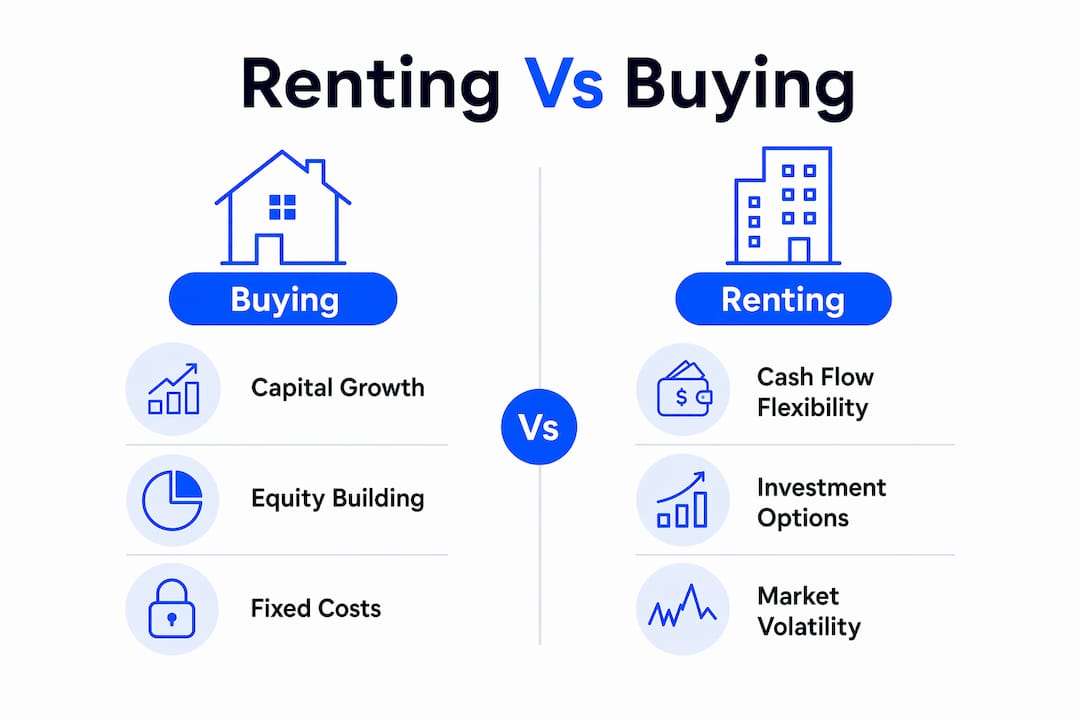
Cash flow is where renting wins in the short term, and it is not subtle. Mortgage repayments for median homes in Sydney exceed $8,100 per month, while median rent sits at approximately $600 per week nationally. That is a significant monthly gap that renters can redirect into investments, if they actually do so.
The cash flow story changes dramatically over time. Mortgage repayments remain fixed or decrease as you pay down your loan. Rents rise. After mortgage payoff, homeowners enjoy rent-free living while renters face escalating costs with no end point. The cash flow crossover typically arrives 20–25 years into ownership, after which buyers live for free and renters keep paying.
| Stage | Buyer position | Renter position |
|---|---|---|
| Years 1–7 | Higher monthly costs, building equity | Lower monthly costs, investing surplus (if disciplined) |
| Years 8–15 | Equity growing, costs stable | Rent rising, investment portfolio growing |
| Years 16–25 | Mortgage reducing, equity compounding | Rent at peak, portfolio must outperform property |
| Post mortgage | Rent-free living, full asset ownership | Ongoing rent with no asset to show |
Rental market volatility adds a risk that rarely appears in financial models. Renters face lease non-renewals, sudden rent increases, and forced relocations. Each forced move carries real costs in time, money, and disruption to employment and schooling. Buyers face none of these pressures once they own their home.
Pro Tip: When budgeting for homeownership, add council rates, building insurance, and an annual maintenance allowance of roughly 1% of the property’s value to your mortgage repayment. Buyers who ignore these costs underestimate the true cost of ownership and get caught short.
What lifestyle factors should influence your renting vs buying decision?
The rent vs buy debate is fundamentally about investment discipline and lifestyle fit, not just financial returns. Your career stage, family situation, and geographic flexibility needs all affect which path builds more wealth for you specifically.
Renting offers genuine advantages that financial models often undervalue:
- Geographic flexibility. Renters can relocate for career opportunities without the cost and delay of selling a property. This option value is real and can translate directly into higher lifetime income.
- Lower upfront capital requirement. Renting frees capital for other investments, business ventures, or emergency reserves.
- No exposure to property-specific risks. Structural defects, neighbourhood decline, and local market downturns affect buyers far more than renters.
- Ability to live in desirable locations. Renting in a suburb you could never afford to buy in can improve quality of life and career access simultaneously.
Buying offers a different set of advantages that go beyond pure financial returns. Stability and control matter. You can renovate, keep pets, and put down roots without a landlord’s approval. The forced savings effect of mortgage repayments is a powerful psychological mechanism. Most people save more consistently when they have no choice than when saving is optional.
The risk of over-leveraging is real. Buyers who stretch to their maximum borrowing capacity leave themselves exposed to interest rate rises, job loss, or unexpected expenses. A property that ties up all your capital and leaves no buffer is a financial liability, not an asset. The wealth-building case for buying depends on holding the property through market cycles, which requires financial resilience that over-leveraged buyers often lack.
Renters who lack investment discipline consistently underperform buyers over long periods. Most renters fail to consistently invest their surplus, which undermines the theoretical financial benefits of renting and investing. If you know you will not invest the difference every month without fail, buying is almost certainly the better wealth outcome for you.
How do Australian tax policies and government incentives affect wealth outcomes?
Australian tax policy tilts the playing field significantly towards buyers. The capital gains tax exemption on your primary residence is the most valuable tax concession available to most Australians. A renter investing in shares or investment property pays capital gains tax on every dollar of growth. A homeowner pays nothing on the growth of their main residence, regardless of how large that gain becomes.
Government incentives add further upfront value for buyers:
- First Home Owner Grants provide direct cash assistance to eligible first buyers, varying by state and territory.
- Stamp duty concessions reduce or eliminate one of the largest upfront costs of buying. Government schemes including the 5% Deposit Scheme, First Home Owner Grants, and stamp duty concessions create a combined lifetime advantage of $30,000–$60,000 for eligible buyers.
- Stamp duty full cost ranges from $15,000 to $55,000-plus depending on the state and purchase price. This cost extends the break-even timeline, so accessing concessions meaningfully accelerates the point at which buying outperforms renting.
- Rentvesting forfeits most of these benefits. Buying an investment property while renting your home means you pay capital gains tax on the investment property’s growth and miss the primary residence exemption entirely.
Pro Tip: Before modelling your rent vs buy decision, check your state’s current stamp duty concessions and First Home Owner Grant eligibility. These figures change regularly and can shift your break-even timeline by several years. Wealthstacker’s modelling tools account for these incentives automatically.
The asset test implications for renters also deserve attention. Renters who build large investment portfolios may face reduced access to government benefits in retirement, while a primary residence is generally exempt from the Age Pension assets test. Over a 30-year horizon, this difference in retirement income can be substantial.
Key takeaways
Buying a home builds greater long-term wealth than renting for most Australians, primarily because of capital growth leverage, tax-free gains on the main residence, and the forced savings discipline that mortgage repayments create.
| Point | Details |
|---|---|
| Capital growth drives the gap | Buyers with annual growth above 5% accumulate $140,000–$460,000 more than renters over the same period. |
| Hold for at least 7–12 years | Transaction costs of 5–6% make buying a poor outcome for short holding periods. |
| Tax-free gains are decisive | The capital gains tax exemption on a primary residence can create a wealth difference exceeding $1 million at retirement. |
| Renting works only with discipline | Renters who consistently invest their surplus can match buyers, but most do not sustain this over 20-plus years. |
| Government incentives favour buyers | Grants and concessions worth $30,000–$60,000 reduce upfront costs and shorten the break-even timeline for eligible buyers. |
Model your own rent vs buy scenario with Wealthstacker
The numbers in this article tell the general story. Your personal outcome depends on your income, deposit size, target suburb, investment habits, and how long you plan to stay put. Generic comparisons only take you so far.
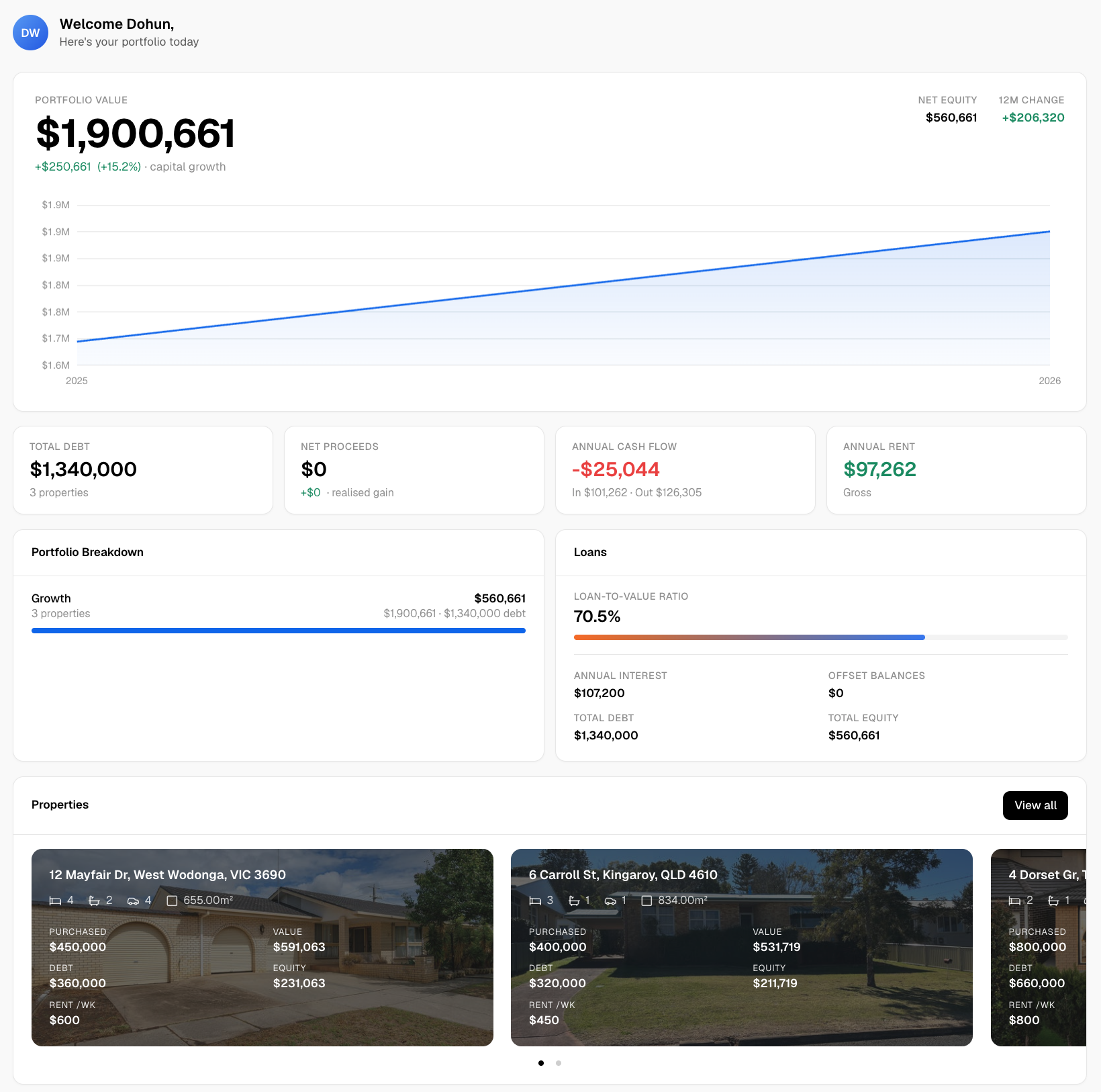
Wealthstacker is built specifically for this kind of personalised property modelling. The platform provides automated quarterly property valuations, real-time net worth projections, and side-by-side modelling for both buying and rentvesting strategies. It accounts for Australian-specific factors including stamp duty, First Home Owner Grants, and capital gains tax treatment. Whether you are a renter weighing your options or a buyer tracking your portfolio, Wealthstacker gives you the data to make a decision grounded in your actual financial position, not someone else’s averages.
FAQ
Is renting always a waste of money?
Renting is not a waste of money if you consistently invest your surplus cash into a diversified portfolio. The problem is that most renters do not maintain this discipline over 20-plus years, which is why buying typically produces better long-term wealth outcomes.
How long do you need to own a home before buying beats renting?
Break-even wealth for buyers typically occurs between 7–12 years in major Australian cities, after accounting for stamp duty and transaction costs totalling 5–6% of the property value.
What is the biggest tax advantage of buying over renting in Australia?
The capital gains tax exemption on your primary residence is the most significant advantage. This exemption can create a wealth difference exceeding $1 million at retirement compared to a taxed investment portfolio, even with modest property growth of 3.5% annually.
What is rentvesting and does it build as much wealth as buying your home?
Rentvesting means renting where you live while buying an investment property elsewhere. It can build substantial wealth, but you forfeit the primary residence capital gains tax exemption and most first home buyer incentives, which reduces the net advantage compared to owner-occupying.
How does Wealthstacker help with the rent vs buy decision?
Wealthstacker models cash flow and net worth projections for both buying and renting scenarios, incorporating Australian tax rules and government incentives. It updates property valuations quarterly so your modelling stays current as market conditions change.