
Property valuation reports explained for Australian investors
A property valuation report is a formal, expert opinion of a property’s market value, prepared by a registered valuer to recognised industry standards. For Australian investors, three things matter immediately: the report’s stated purpose, who prepared it, and whether a physical inspection was carried out. Bodies like the Australian Property Institute (API) and the Royal Institution of Chartered Surveyors (RICS) set the standards that make a valuation legally defensible. The Australian Taxation Office (ATO) has its own expectations for tax-purpose valuations. Automated tools like Wealthstacker sit alongside these formal reports as a portfolio-level cross-check, not a replacement.
When a report lands in your inbox, do these three things first:
- Confirm the purpose. A mortgage security valuation and a capital gains tax valuation carry different assumptions. Using the wrong one for your situation is a common and costly mistake.
- Check the valuer’s credentials. Look for API or RICS membership and state registration. Agent appraisals are marketing tools with conflicts of interest and cannot substitute for a formal valuation in critical decisions.
- Verify a physical inspection occurred. A report without an inspection date and photos is a red flag, not a formal valuation.
Table of Contents
- What a standard Australian valuation report contains
- Who can legally produce a recognised valuation in Australia?
- AVMs versus formal valuations: which one do you actually need?
- How investors should use valuation reports in real decisions
- What to check when a valuation report arrives
- Your immediate checklist after receiving a valuation report
- Standards, compliance, and what a valuation can and cannot do
- Key takeaways
- Wealthstacker gives you an automated cross-check between formal valuations
- Useful sources and further reading
What a standard Australian valuation report contains
A comprehensive valuation report covers far more than a single dollar figure. Each component serves a specific purpose for investors reading the report critically.
| Component | What to check | Why it matters |
|---|---|---|
| Purpose of valuation | Matches your intended use (lending, tax, sale) | Wrong purpose = unusable report |
| Property address and title | Correct lot, plan, and volume/folio | Errors here invalidate the report |
| Inspection date and photos | Recent date; internal and external photos present | Proves scope; photos catch condition issues |
| Zoning and planning overlays | Current zone, overlays, easements noted | Affects development potential and risk |
| Identified risks | Flood, bushfire, contamination, heritage | Material to value and insurability |
| Comparable sales evidence | Recent, local, adjusted sales with addresses | Underpins the value estimate |
| Methodology | Market, income, or cost approach stated | Lets you assess appropriateness |
| Market value opinion | Single figure or defensible range | The core output |
| Assumptions and limitations | Clearly listed | Sets the boundaries of reliance |
| Valuer declaration and signature | Signed, dated, credentials listed | Confirms compliance and accountability |
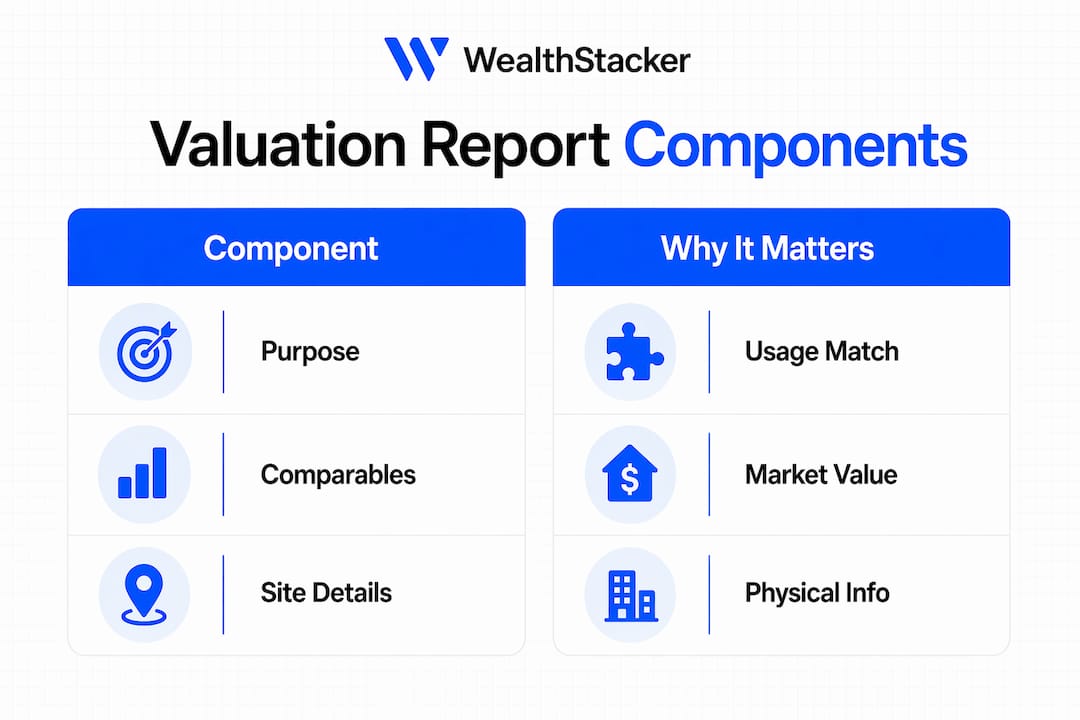
The comparable sales section deserves the most scrutiny. A valuer should list each comparable’s address, sale date, price, and the adjustments made for differences in size, condition, and location. If that detail is absent, the value estimate has no visible foundation.
Who can legally produce a recognised valuation in Australia?
Only registered or certified valuers with tertiary qualifications in property valuation can produce a formally compliant report. State registration boards operate across most Australian jurisdictions, and professional membership of the API or RICS signals that the valuer is bound by enforceable codes of conduct and continuing education requirements.
What those membership badges actually mean for you:
- API membership indicates the valuer follows API Valuation Protocols, which align with International Valuation Standards (IVS). The API’s 2025 Valuation Protocol explicitly requires methodology to be consistent with IVS terminology.
- RICS membership signals adherence to RICS Red Book standards, which are internationally recognised and carry their own compliance obligations.
- State registration (where applicable) is the legal baseline. Membership of API or RICS is the professional quality signal on top of that.
A formal valuation requires a physical inspection — internal and external — to meet IVS and Australian practice standards. A report produced without an inspection cannot be IVS-compliant, regardless of how detailed the written analysis appears. Always check the inspection date and confirm photos are included before relying on any report.
A formal valuation is an expert opinion, not a guaranteed sale price. Two qualified valuers working from the same brief may reach slightly different, equally defensible figures depending on which comparables they weight most heavily.
AVMs versus formal valuations: which one do you actually need?
Automated valuation models (AVMs) use statistical matching against recent sales and property attributes to generate an estimate quickly and cheaply. Formal valuations involve a registered valuer applying professional judgement after a physical inspection. The difference is not just process — it determines what the output can legally be used for.
| Dimension | AVM | Formal valuation |
|---|---|---|
| Purpose | Suburb screening, portfolio tracking | Lending, tax, legal, high-stakes purchase |
| Inspection | None | Physical (internal and external) |
| IVS compliance | No | Yes (when correctly instructed) |
| Methodology | Statistical/algorithmic | Market, income, or cost approach |
| Scope | Modelled estimate | Documented, defensible opinion |
| Reliance | Portfolio cross-check only | Legally defensible |
AVMs do not account for site-specific physical attributes: structural condition, internal finishes, easements, or planning overlays. A property with a heritage overlay or a flood-affected rear yard will look identical to a clean comparable in an AVM’s dataset. Professional judgement cannot be replaced by an algorithm for IVS compliance, even when AI assists with data gathering.
Pro Tip: Order a formal valuation even when an AVM shows a figure close to your offer price if: the comparable pool in the suburb is thin (fewer than five recent sales), the property has been renovated, or you are bidding at auction where the cost of being wrong is immediate and irreversible.
Wealthstacker’s automated quarterly valuations sit firmly in the AVM category — genuinely useful for tracking portfolio-level trends, but not a substitute for a commissioned formal valuation when the stakes are high.
How investors should use valuation reports in real decisions
Knowing when to use each type of valuation saves money and prevents costly errors. Here is a practical sequence:
- Pre-offer forensic comparables. Before making an offer, run a forensic comparable analysis — normalise and score recent sales across size, condition, and location. This gives you a defensible price anchor independent of the agent’s appraisal.
- Auction bidding limit. Set your ceiling before you walk in. A formal valuation or a rigorous comp analysis prevents emotional overbidding.
- Post-purchase refinancing. Banks commission their own valuations to protect the lender, and bank valuations tend to be conservative — they assess security value, not the highest achievable market price. If the bank’s figure comes in low, you can commission an independent valuation to negotiate.
- Capital gains tax or family law. The ATO and courts require valuations instructed for the correct purpose and date. A mortgage valuation repurposed for CGT is unlikely to satisfy ATO scrutiny.
- Portfolio tracking. Quarterly AVM cross-checks (Wealthstacker’s free toolkit does this) keep your equity estimates current between formal valuations.
On cost: desktop valuations typically cost a low fee, kerbside valuations more, and a full independent residential valuation a higher fee. Bank-commissioned full valuations are usually moderate in price. Turnaround for a standard residential report is usually within a few business days. Understanding how valuations affect your borrowing capacity is worth reading before you refinance.
What to check when a valuation report arrives
Most investors read the value figure and stop. That is the wrong approach. Work through these checks systematically.

| Check | Red flag | Action |
|---|---|---|
| Inspection date present | Missing or outdated | Request a fresh inspection |
| Photos included | No internal photos | Query the scope with the valuer |
| Comparables listed with detail | Fewer than 3, or outside the suburb | Ask for normalisation notes |
| Valuer registered and credentialled | No API/RICS membership listed | Verify independently before relying |
| Purpose matches your use | Purpose differs from your application | Commission a new report |
| Assumptions clearly stated | Vague or absent | Request a written clarification |
Questions worth asking the valuer directly:
- “What was the stated purpose of this valuation, and does it match my intended use?”
- “When was the inspection conducted, and were all rooms accessed?”
- “Which comparable sales most influenced the figure, and how were they adjusted?”
Pro Tip: If the report contains a factual error — wrong bedroom count, incorrect land size — contact the valuer in writing immediately. Most will issue a corrected report at no charge. Do not let an error stand; it flows through to your borrowing power and any tax calculation that relies on the figure.
When comparables look thin, ask whether the valuer applied cross-checks such as price-per-square-metre land analysis or land-to-asset ratios, and whether any outlier sales (mortgagee sales, related-party transactions) were excluded.
Your immediate checklist after receiving a valuation report
Five things to confirm before you act on any valuation:
- Purpose confirmed. The stated purpose matches your use case (lending, tax, sale, portfolio).
- Physical inspection verified. Inspection date present; internal and external photos included.
- Comparables credible. At least three recent, local, adjusted sales with addresses and dates.
- Valuer credentialled. API or RICS membership and state registration confirmed.
- Assumptions and limitations read. You understand what the report does and does not cover.
Within 24 hours: run an AVM cross-check (Wealthstacker’s free quarterly estimate works for this), check the listed comparables against public sales data, and flag any factual errors to the valuer in writing. What can wait: commissioning a second formal valuation unless the figure is materially lower than your offer or the deal is contested.
Standards, compliance, and what a valuation can and cannot do
The ATO’s market valuation guidance sets out minimum requirements for tax-purpose reports: the purpose, scope, asset details, assumptions, valuation date, methodology, and the valuer’s identity and qualifications must all be documented. The governing standards are the IVS (International Valuation Standards) and, for Australian practitioners, APES 225 and API protocols. A report that omits any of these elements is unlikely to satisfy ATO review.
A valuation report is an expert opinion of value at a specific date — it is not a guaranteed sale price, and it is not transferable between purposes. A report instructed for mortgage security cannot be repurposed for a capital gains tax calculation without a new instruction and, usually, a new report. Always confirm the purpose before relying on any valuation for tax, legal, or estate matters.
The valuation purpose is paramount: instructing the wrong purpose produces a report that is unusable for the investor’s actual application, regardless of how thorough the analysis is. For retrospective tax valuations, the valuation date can be historical — which matters directly for capital gains calculations.
This article is general information, not financial, tax, or legal advice. Confirm the requirements for your specific situation with a registered valuer, tax agent, or qualified adviser.
Key takeaways
A formal valuation is only as useful as its stated purpose — always confirm it matches your application before relying on the figure.
| Point | Details |
|---|---|
| Purpose determines usability | A mortgage valuation cannot be repurposed for CGT or family law without a new report. |
| Credentials are non-negotiable | Only API or RICS-registered valuers produce IVS-compliant reports; always verify membership. |
| Physical inspection is required | No inspection date and photos means the report is not formally compliant — request one. |
| AVMs are screening tools only | Automated estimates suit portfolio tracking but are not legally defensible for lending or tax. |
| Wealthstacker for ongoing tracking | Use Wealthstacker’s free quarterly valuations as a portfolio cross-check between formal reports. |
Wealthstacker gives you an automated cross-check between formal valuations
Formal valuations are essential for lending, tax, and legal decisions. Between those milestones, most investors have no reliable way to track whether their portfolio’s equity is growing, shrinking, or stalling. That is the gap Wealthstacker fills.
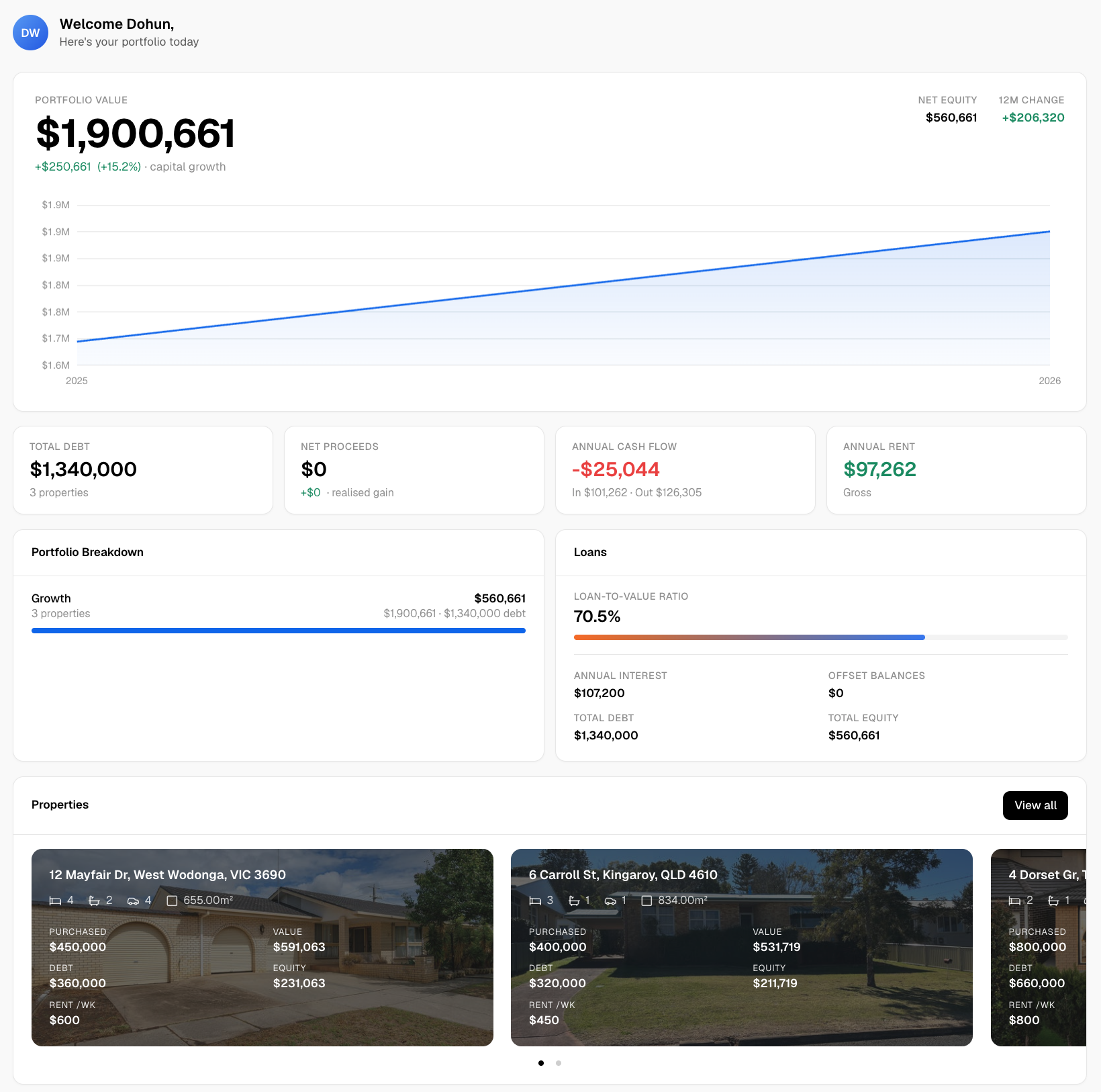
Wealthstacker’s free toolkit delivers automated quarterly property valuations, a portfolio tracking dashboard, borrowing-power estimations, and hazard and risk overlays for Australian suburbs. The 15-year modelling tools let you compare rentvesting and buying scenarios side by side, so you can see how a valuation shift today affects your projected net worth over a decade. None of this replaces a formal valuation when one is legally required. It does mean you are never flying blind between them.
Run your free automated cross-check at Wealthstacker, then commission a formal valuation from a registered API or RICS valuer when the deal, the tax event, or the refinancing requires one.
Useful sources and further reading
Primary sources used in this guide:
- ATO Market Valuation Guide — the ATO’s minimum requirements for tax-purpose valuation reports, including documentation, methodology, and valuer qualification expectations.
- API Valuation Protocol (2025) — the Australian Property Institute’s guidance on IVS-aligned valuation approaches and methods for registered valuers.
- Landmark Valuations: What is a Property Valuation? — a clear overview of valuation types, uses, and the difference between bank and private valuations.
- Property Principles: How to Value a Property — practical guidance on forensic comparable analysis and the limits of AVMs and agent appraisals.
- HKV: How Property Valuations Are Conducted — a step-by-step explanation of the valuation process and the expert-opinion nature of formal reports.
Wealthstacker further reading:
- What is a property valuation? — primer on valuation types and how AVMs compare to formal reports.
- Property investment reporting best practices — how to structure valuation-driven reporting for portfolio compliance.
- Role of AI tools in property valuation — where AI assists valuers and where it cannot replace professional judgement.