
Why dual income households invest in property faster
Dual income households move faster in the Australian property market for one straightforward reason: two salaries do more than double your options. They compress the timeline from “thinking about it” to “settlement day” by boosting borrowing capacity, slashing the time needed to save a deposit, and creating a financial buffer that single income buyers simply cannot replicate. Combined incomes assessed under the Household Expenditure Measure (HEM) give lenders more to work with, even after accounting for higher shared living costs. The result is faster loan approval, access to better-located properties, and a stronger position to weather rate rises without selling under pressure.
The primary accelerators for dual income households are:
- Borrowing power: Two incomes assessed together unlock higher loan limits, often enabling purchases in suburbs with stronger long-term capital growth.
- Deposit speed: Shared living costs and pooled savings mean deposits accumulate faster, reducing time out of the market.
- Cash flow stability: Two income streams reduce the risk of missed repayments during job changes, illness, or rate increases.
- Financial tools: Offset accounts and split loans let couples manage surplus cash efficiently, cutting interest costs and preserving future borrowing capacity.
Table of Contents
- What are dual income properties and how do they work?
- What financial benefits do dual incomes bring to property investment?
- Why dual income properties suit investors building a portfolio
- How loan and ownership structures shape wealth outcomes
- How to plan for sustainable property investment as a couple
- How long does it take: single vs dual income households
- Common financial challenges dual income households face
- How dual income affects credit scores and loan approvals
- Australian tax laws for dual income property investors
- Real-world examples of dual income couples investing faster
- Key takeaways
What are dual income properties and how do they work?
A dual income property generates two separate rental streams from a single title. The most common forms are dual key homes (two self-contained dwellings under one roof, each with its own entrance) and dual occupancy properties (two distinct residences on one lot, sometimes with a shared wall). Both sit on one certificate of title, which simplifies ownership and financing compared to buying two separate investment properties.
The structural appeal is straightforward. If one tenancy sits vacant, the other continues generating rent. Two separate rent streams from one property can improve combined gross yield compared to a standard single dwelling, which matters considerably when serviceability is tight.
Key characteristics of dual income properties:
- One title, two dwellings or tenancies
- Each dwelling is self-contained with separate amenities
- Zoning must permit dual occupancy (varies by council and state)
- Design typically includes separate entrances to maximise tenant privacy
- Can attract a broader tenant pool: families, couples, singles, and multi-generational households
Pro Tip: Before purchasing a dual income property, confirm the local council’s zoning permits dual occupancy and check whether a development approval is required. Some councils restrict dual key configurations in certain residential zones, which can affect both rental legality and resale value.
Zoning and regulatory requirements differ across Australian states and territories. In Queensland, for example, dual occupancy is generally permitted in low-medium density residential zones, while some Sydney councils require a development application even for internal dual key configurations. Getting this wrong at purchase can mean one dwelling cannot be legally tenanted.
What financial benefits do dual incomes bring to property investment?
The financial advantages of two incomes extend well beyond a larger loan. They reshape the entire investment equation.
Borrowing capacity and loan terms
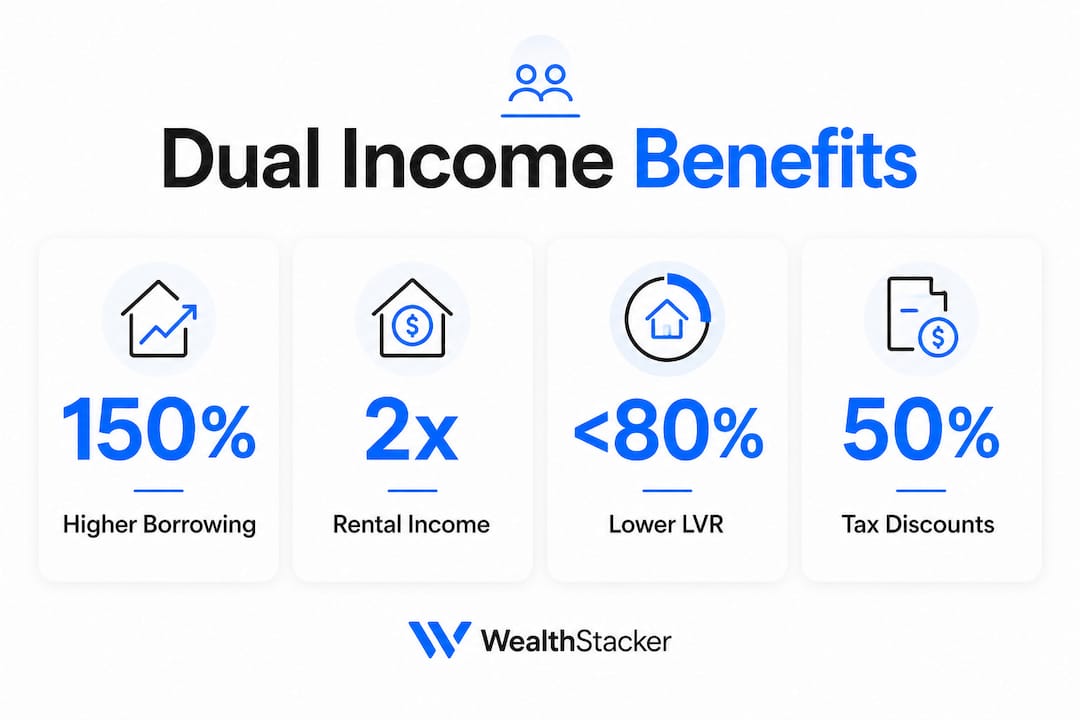
Lenders assess combined income against combined expenses. Even with HEM benchmarks applied to shared living costs, the net borrowing capacity of a dual income household typically exceeds what either partner could access individually. That gap is often enough to move from a secondary suburb to a primary one, with meaningfully different long-term growth prospects. Higher entry price tolerance enables purchases in locations with stronger wealth creation characteristics.
Rental yield and cash flow
Dual income properties generate two rent streams, which improves gross yield and reduces the carrying cost of the mortgage. For investors focused on holding through market cycles rather than selling, this cash flow resilience is the difference between a property that pays for itself and one that requires constant top-ups.
Tax efficiency
Negative gearing, depreciation, and property-related deductions apply to both dwellings in a dual income property. A newly built dual income property attracts higher depreciation deductions than an established single dwelling, because there are simply more depreciable assets across two dwellings. Loan interest, council rates, property management fees, and maintenance costs are all deductible against rental income.
| Metric | Single income investor | Dual income household |
|---|---|---|
| Borrowing capacity | Limited to one salary assessment | Combined salaries assessed together |
| Deposit timeline | Longer, higher proportion of single income | Shorter, pooled savings accelerate readiness |
| Rental income (dual property) | One stream | Two streams, yield improvement |
| Tax deductions | Standard single dwelling | Higher depreciation across two dwellings |
| Risk exposure | Higher, single income buffer | Lower, two incomes absorb shocks |
Loan-to-value ratio
A larger deposit, built faster through pooled savings, lowers the loan-to-value ratio (LVR). Dropping below 80% LVR eliminates lenders mortgage insurance (LMI), which can save tens of thousands of dollars on a typical Australian property purchase. It also unlocks sharper interest rates from most lenders.
Why dual income properties suit investors building a portfolio
Beyond the numbers, dual income properties offer operational advantages that compound over time.
- Vacancy resilience: One vacant dwelling does not stop cash flow entirely. The second tenancy continues covering a portion of mortgage repayments.
- Reinvestment speed: Stronger cash flow means surplus income can be redirected toward the next deposit sooner, accelerating portfolio growth strategies.
- Lifestyle flexibility: Owners can live in one dwelling and rent the other, reducing personal housing costs while building equity. This suits younger couples entering the market.
- Tenant diversity: A property with a four-bedroom and a two-bedroom dwelling attracts families, couples, and singles simultaneously, reducing extended vacancy periods.
- Multi-generational use: One dwelling can house family members while the other generates income, a growing consideration as housing affordability tightens across Australian capitals.
Alternative lenders and private credit providers often assess dual income properties more favourably than retail banks, recognising the compounded rental yield and offering progressive construction finance suited to complex builds. Non-bank lenders fill gaps the major banks leave, particularly for investors building new dual occupancy homes where drawdown schedules differ from standard construction loans.
How loan and ownership structures shape wealth outcomes
Getting the structure right before settlement is as important as choosing the right property. Poor structuring can erode the financial advantages dual incomes provide.
Borrowing power calculations
Lenders apply HEM benchmarks to estimate combined living expenses, which means the borrowing boost from two incomes is real but not simply additive. Unused credit card limits are treated as liabilities regardless of whether balances are zero, quietly reducing overall borrowing capacity. Cancelling unused cards before applying is one of the most overlooked pre-application steps.
Joint tenancy vs tenants in common
Co-ownership structure selection has long-term financial consequences:
- Joint tenancy assumes equal ownership shares. If one partner dies, ownership passes automatically to the survivor, bypassing the estate. This suits couples with equal contributions and aligned estate planning goals.
- Tenants in common allows unequal ownership splits (e.g. 60/40 or 70/30), which can reflect unequal income contributions and optimise capital gains tax outcomes by directing more gain to the lower-income earner.
Experts recommend formalising co-ownership agreements early, particularly where income contributions differ. A written agreement covering decision-making, exit scenarios, and cost-sharing prevents disputes that can force premature sales.
Offset accounts and split loans

Split loans allow interest tracking per borrower, while offset accounts reduce interest payable by parking surplus cash against the loan balance. Together, these tools let dual income households manage cash flow without sacrificing future borrowing capacity. A couple with one fixed and one variable loan component can hedge against rate movements while maintaining flexibility to make extra repayments.
Pro Tip: Structure ownership percentages to reflect each partner’s income contribution before settlement, not after. Changing ownership splits post-purchase triggers stamp duty and potentially capital gains tax in most Australian states.
How to plan for sustainable property investment as a couple
Borrowing the maximum a lender will approve is rarely the right move. The Australian property market rewards patience and holding power, not just entry price.
Sustainable planning for dual income households involves:
- Borrowing within comfortable limits: Leave a buffer for rate rises, income changes, or unexpected costs. A loan that requires both incomes at full capacity to service leaves no room for career breaks, parental leave, or redundancy.
- Using offset accounts actively: Parking surplus income in an offset account reduces daily interest without locking funds away. This is particularly useful when one partner’s income fluctuates.
- Retaining future borrowing capacity: Avoid structuring the first investment in a way that exhausts both partners’ borrowing power. A borrowing capacity assessment before committing helps map out what the second purchase might look like.
- Formalising financial agreements: A written co-investment agreement covering contribution ratios, decision rights, and exit conditions protects both partners and reduces the risk of costly disputes.
- Reviewing the portfolio regularly: Property values, rental income, and personal circumstances all shift. Annual reviews allow loan structures to be adjusted before problems emerge.
Pro Tip: Rather than maximising your borrowing limit, target a loan that remains serviceable on one income alone. This single rule protects against the most common forced-sale scenario: one partner losing income unexpectedly.
How long does it take: single vs dual income households
The timeline difference between single and dual income households is most visible in two stages: saving the deposit and qualifying for the loan.

A single income earner saving a 20% deposit on a median Australian property while covering full living costs independently faces a materially longer runway than a couple splitting those same costs. When two incomes are pooled and living expenses shared, the surplus available for savings each month is disproportionately larger than simply doubling one person’s savings rate. Shared rent or mortgage costs, utilities, and groceries mean each dollar of combined income goes further.
On the lending side, a joint application assessed on two incomes typically qualifies for a larger loan sooner, enabling market entry before a single income applicant has accumulated a sufficient deposit. In practical terms, couples investing together in Australian capital cities often reach their first investment property one to three years ahead of comparable single income buyers, depending on income levels and savings discipline. That head start compounds: earlier entry means earlier equity growth, which can be used to fund the next purchase via equity leverage strategies.
Common financial challenges dual income households face
Two incomes do not eliminate risk. They redistribute it.
Tied borrowing power: A joint loan appears on both credit files. If the couple wants to purchase a second investment property, both partners’ borrowing capacity is already partially committed. This is why structuring the first purchase carefully matters so much.
Income dependency: If one partner’s income drops significantly, serviceability can deteriorate quickly, particularly on a loan sized to both incomes at full capacity.
Differing risk tolerance: Partners often have different views on leverage, property type, and timing. Without a shared investment plan, decisions become slower and more contentious.
Lifestyle creep: Higher combined income can lead to higher combined spending, which erodes the savings advantage. Maintaining a disciplined savings rate as incomes grow is harder than it sounds.
The most effective counter to these challenges is a written investment plan agreed before the first purchase, covering borrowing limits, target property types, contribution ratios, and a clear process for resolving disagreements.
How dual income affects credit scores and loan approvals
A joint mortgage application does not automatically produce a better credit outcome. Both partners’ credit histories are assessed individually. A strong income from one partner cannot offset a poor credit score from the other; lenders evaluate the weakest file in the application.
What dual income does improve is the debt-to-income ratio, a metric lenders weight heavily in serviceability assessments. Higher combined income relative to the proposed debt load signals lower default risk, which can improve approval odds and sometimes unlock better interest rate tiers.
Unused credit card limits remain one of the most underestimated drags on joint applications. A couple with $30,000 in combined unused credit limits may find their assessed borrowing capacity reduced by more than the limit itself, because lenders model the scenario where both cards are drawn to their maximum.
Before applying, both partners should review their credit reports via a service like Equifax or Illion, close unused credit accounts, and avoid new credit applications in the three to six months preceding a mortgage application.
Australian tax laws for dual income property investors
Australian tax law treats investment property income and deductions at the individual level, not the household level. This creates both opportunities and obligations for dual income couples.
Negative gearing allows investors to deduct property losses (where expenses exceed rental income) against other assessable income, including salary. For a dual income household, this means both partners can potentially claim deductions against their respective incomes, depending on ownership structure.
Capital gains tax (CGT): When a property held for more than 12 months is sold, the capital gain is discounted by 50% for individuals. Ownership structure determines how the gain is split. Tenants in common with a 60/40 split allocates 60% of the gain to one partner and 40% to the other, which can be tax-efficient if one partner is in a lower marginal tax bracket.
Depreciation: The Australian Taxation Office (ATO) allows investors to claim depreciation on the building structure (Division 43) and plant and equipment (Division 40). A newly built dual income property generates higher depreciation claims than an established single dwelling, because both dwellings contain depreciable assets.
Land tax: Each state and territory applies land tax differently. In most jurisdictions, investment properties are subject to land tax above a threshold. Dual income properties on one title are assessed as a single property for land tax purposes, which can be advantageous compared to owning two separate investment properties.
Engaging a tax accountant with property investment experience is worth the cost. The interaction between negative gearing, CGT, depreciation, and ownership structure is specific to each couple’s income levels and long-term goals.
Real-world examples of dual income couples investing faster
Consider two scenarios set in South East Queensland, one of Australia’s most active growth corridors for dual income property investment.
Scenario A: A couple, both working full-time, pool their savings over 18 months and accumulate a 20% deposit on a dual key property in a regional growth corridor. Their combined income qualifies them for a loan that would be out of reach for either partner individually. With two rental streams covering the majority of mortgage repayments, they hold the property comfortably through a rate rise cycle and use the equity two years later to fund a second purchase.
Scenario B: A single income buyer targeting the same suburb takes 32 months to save an equivalent deposit while covering full living costs alone. By the time they enter the market, property values in the corridor have moved, and their budget now reaches a less established location with lower long-term growth fundamentals.
The gap between these two timelines is not just about income. It is about the compounding effect of entering the market earlier, in a better location, with a more resilient cash flow structure. South East Queensland’s dual income property demand continues to grow as investors prioritise income resilience alongside capital growth, supported by population migration, infrastructure investment, and tight rental conditions.
Wealthstacker’s property investment modelling tools let dual income households model both scenarios in real time, comparing projected net worth across different entry points, loan structures, and property types before committing to a purchase.
Key takeaways
Dual income households invest in property faster because combined finances compress every stage of the investment timeline, from deposit savings to loan approval to portfolio growth.
| Point | Details |
|---|---|
| Borrowing power advantage | Combined incomes unlock higher loan limits, enabling access to better-located properties sooner. |
| Faster deposit accumulation | Shared living costs free up more surplus income, cutting deposit timelines by months or years. |
| Dual income property yield | Two rental streams on one title improve gross yield and reduce vacancy risk. |
| Structure determines outcomes | Tenants in common suits unequal contributions; offset accounts and split loans protect cash flow. |
| Sustainable borrowing matters | Sizing loans to remain serviceable on one income protects against the most common forced-sale trigger. |