
12 Month Net Cash Test: 4 Step Sell or Hold for Australian Property
Sell if your property is a sustained net cash drain once you stress-test the numbers, and there’s no clear higher-return use for the equity trapped inside it. Hold if it’s cash flow neutral or better, there’s no imminent capital works bill, and you’d genuinely miss the growth. Before you decide either way, build a 12-month net cash model with a rate stress test. Some online modelling tools do this automatically, and the Australian Taxation Office sets out exactly what counts as deductible along the way.
TL;DR:
- Negative cash flow persists if stress testing shows a shortfall exceeding several months of reserves under increased interest rates and vacancy shocks.
- Major capital works or liabilities create a strong sell signal if they lack offsetting rent increases and threaten to worsen cash flow.
- Market signals like declining auction clearance rates below 55% and rising days on market suggest prices may soften further, affecting hold decisions.
- Changes in tax laws and rising selling costs can reduce net proceeds, making holding less attractive if the property underperforms financially.
- Regularly update your net cash model and set predefined triggers to plan proactive sales before market conditions worsen.
WealthstackerModel Your Property Decision ClearlyWealthStacker helps you compare rentvesting and buying strategies, with automated quarterly valuations and personalised modelling for real estate decisions.Explore WealthStacker
Table of Contents
- Quick decision checklist: three-lens triage
- How to model net cash returns (practical walkthrough)
- Market outlook and timing: which indicators matter
- Tax and cost considerations that change the maths
- Step-by-step decision method: model, stress-test, compare alternatives
- Signs you should sell now
- Signs you should hold and active steps while holding
- WealthStacker: using the toolkit to run the method above
- Emotional and lifestyle factors influencing the sell or hold decision
- Exit strategy planning including contingency if market conditions worsen
- Sources
Quick decision checklist: three-lens triage
Run your property through three lenses before you do anything else. This takes ten minutes and tells you whether you need a deeper model or a fast decision.
- Net monthly cash after all expenses. Add up rent received, then subtract mortgage interest, rates, insurance, management fees, strata (if applicable) and a maintenance reserve. Is the number positive, break-even, or bleeding?
- Imminent capital works or liabilities. Is there a strata special levy coming, a roof that’s failing, or an ageing hot water system with six months left in it?
- Opportunity cost of the equity. If you sold tomorrow and banked the proceeds after costs and tax, could that money earn a better return elsewhere?
Pro Tip: Calculate your net cash after interest and fees right now, using your actual mortgage statement from last month. Most investors are working off numbers that are twelve months out of date, and rates have moved since then.
If lens one is negative, lens two shows a big bill coming, and lens three reveals an obvious better use for the money, that’s three sell signals stacking up. One weak lens usually means hold and monitor.
How to model net cash returns (practical walkthrough)
A property’s market value alone does not determine whether you should keep it. What matters is the net cash position, and that means putting real numbers against every line item:
- Rent, minus a realistic vacancy allowance (4 to 6 weeks a year is typical for most capital cities)
- Mortgage interest at your current rate, then again at a stressed rate
- Property management fees (usually 5 to 8% of rent)
- Council rates, water rates, and building insurance
- Strata fees where relevant
- A maintenance reserve (1% of property value per year is a reasonable working figure)
- Land tax, if the property pushes you over your state’s threshold
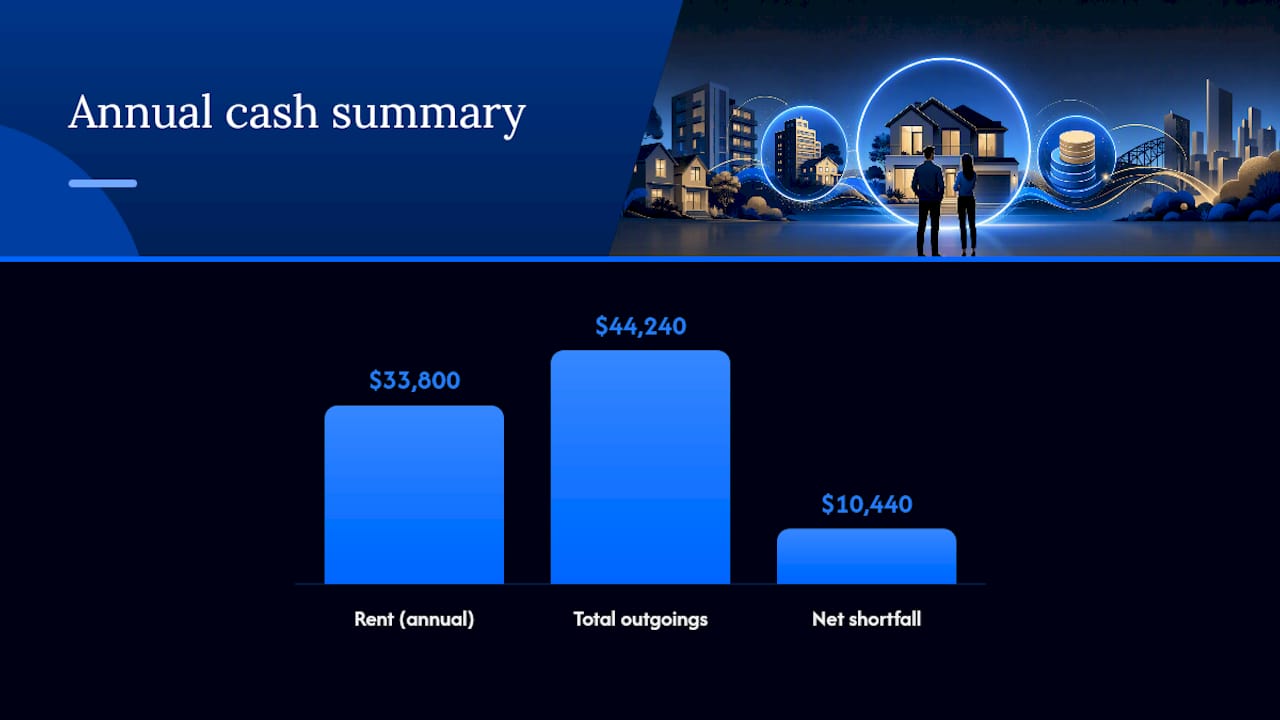
Here’s a worked example. Say a property rents for $650 a week ($33,800 a year), with a mortgage at a prevailing interest rate. Annual interest can substantially impact cash flow. Add $2,700 in rates, $1,800 in insurance, $2,300 in management fees, and a $5,200 maintenance reserve, and total outgoings sit near $44,240 against $33,800 in rent, a shortfall of about $10,440 a year before tax benefits.
Now stress-test it. Analysts recommend running an extra 200 to 300 basis points on the mortgage rate and a 10% vacancy shock when modelling risk. If interest rates rise significantly, the interest bill can increase substantially, turning a manageable shortfall into a genuinely painful one.
The core question is whether rental yield can realistically keep pace with mortgage servicing costs if rates rise again. WealthStacker’s portfolio performance metrics and rental yield guidance are built for exactly this comparison.
Market outlook and timing: which indicators matter
Recent conditions favour caution over conviction. Weaker conditions have spread to 93% of capital-city suburbs, auction clearance rates have softened, and listings have grown while buyer activity has cooled. Commonwealth Bank has flagged further falls in Sydney and Melbourne, with recovery not expected until mid-2027, tied closely to the Reserve Bank’s rate path and shifting tax settings.
A market recovery only matters to your decision if it changes your post-tax outcome. A 5% price bounce two years from now is irrelevant if holding costs you $15,000 a year in negative cash flow between now and then.
Four indicators are worth tracking monthly:
- Auction clearance rates in your suburb: below 55% for two consecutive months signals soft demand.
- Days on market: a jump of more than 20% year on year suggests a buyer’s market taking hold.
- New listing volumes: rising supply with flat clearance rates usually means further price softness ahead, a pattern already visible in recent housing data.
- RBA cash rate moves: two consecutive rate cuts often precede renewed buyer demand within six to nine months.
Local supply and demand dynamics usually override national headlines, so check your own suburb against these thresholds rather than relying on capital-city averages.
Tax and cost considerations that change the maths
Capital gains tax timing impacts your net result. Generally, holding an asset for more than 12 months allows for a capital gains tax discount, so selling in a lower-income year can materially reduce the tax bill.
The 2026 federal budget introduced changes to negative gearing and CGT treatment that take effect from July 2027, and they matter because they can make a marginally positive property less attractive to hold under the new rules. If your gearing strategy depends heavily on current settings, model both the old and new treatment before deciding.
Selling costs add up fast and belong in every model:
- Agent commissions and sale-related costs can significantly reduce your net proceeds.
- Marketing and advertising, often $1,500 to $3,000
- Pre-sale repairs and staging, highly variable but easy to underestimate
Check the negative gearing rules and ATO’s rental property guidance for exact deduction treatment. Tax reasons alone rarely justify holding a property that’s genuinely underperforming. As financial advisors point out, holding purely to avoid CGT can mean absorbing years of losses that outweigh the eventual tax saving, so always weigh the opportunity cost against what that equity could earn elsewhere.
Step-by-step decision method: model, stress-test, compare alternatives
Follow these four steps in order, and don’t skip the stress test even if the base case looks fine.
- Build a 12-month net cash model. Use your actual rent, real mortgage statement, and every recurring cost. This is your baseline.
- Stress-test it. Add 200 to 300 basis points to your mortgage rate and apply a 10% vacancy shock. If your shortfall doubles or turns a small surplus into a loss, you’re running thinner margins than you thought.
- Add sale costs and CGT to model an exit. Calculate net proceeds after agent fees, marketing, and tax, using this year’s income to estimate your CGT bracket.
- Compare returns on the freed equity. Could that money outperform the property elsewhere over a comparable timeframe, after accounting for risk?
Pro Tip: If your stress-tested shortfall exceeds several months of your cash reserves, it’s a prudent signal to take action rather than delay. Fewer than three months of buffer against a rate shock is thin by most lenders’ standards.
Reading the outputs is straightforward once you’ve run them. Properties maintaining positive cash flow under stress tests typically justify holding, while negative cash flow under stress might require refinancing consideration. A property with no upgrade path, a looming special levy, and a shrinking rental market usually means sell now or sell within six months, not sell eventually. WealthStacker’s portfolio metrics checklist gives you the templates to run all four steps without building spreadsheets from scratch.
Signs you should sell now
A handful of signals, taken together, point clearly toward selling:
- Sustained negative net cash flow with shrinking reserves indicates the need for reassessment.
- A major capital works bill is coming (roof, strata special levy, structural repairs) with no offsetting rent increase in sight.
- Local demand drivers are fading (employer closures, oversupply of new stock, population decline).
- You’ve identified a clearly better use for the equity after tax and selling costs.
If three or more of these apply, get a formal appraisal and start planning your exit timeline rather than waiting for market sentiment to improve.
Signs you should hold and active steps while holding
Holding makes sense when income is stable or growing, cash flow is manageable even if slightly negative, and there’s no capital works bomb waiting. A credible path to refinancing at a better rate, or a realistic rent review, tips the balance further toward holding.
While you hold, take action rather than waiting passively:
- Consider refinancing if your current mortgage rate is significantly above prevailing market rates.
- Review rent every 12 months against comparable listings in your suburb.
- Build a dedicated maintenance reserve rather than relying on savings.
- Re-run your net cash model every six months, or immediately after any rate change.
Pro Tip: Regularly review your financial model, such as every six months, to keep pace with market changes.
WealthStacker: using the toolkit to run the method above
Some platforms turn this framework into a live dashboard with quarterly valuations, modelling, borrowing power checks, and scenario comparisons, allowing users to stress-test actual portfolios and see sell-hold guidance update in real time.
Emotional and lifestyle factors influencing the sell or hold decision
Numbers rarely tell the whole story, and pretending otherwise leads to decisions you’ll regret. Personal and emotional factors can influence holding decisions beyond purely financial considerations.
That’s fine, as long as you’re honest about the trade-off you’re making. If you’re choosing to hold a cash-negative property for sentimental reasons, name that decision explicitly rather than dressing it up as a financial call. Know the dollar cost of that choice each year, and decide if it’s a price you’re genuinely willing to pay.
Lifestyle factors cut the other way too. Some investors hold onto a property because selling feels like admitting a mistake, even when the numbers clearly say otherwise. Others keep a rental because managing it has become part of their routine and identity, particularly with retirees who’ve spent a decade as a landlord.
Relationship changes matter here as well. Divorce, a new baby, ageing parents needing care, or a job relocation can all shift what “home” or “investment” means to you almost overnight. A property that made sense for your life five years ago might now be the wrong asset for where you’re headed.
The healthiest approach separates the emotional conversation from the financial one. Run the net cash model first, get a clear-eyed number, and then decide consciously whether emotional value is worth covering that number out of pocket. That’s a real decision. Letting sentiment quietly override the maths without acknowledging it isn’t.
Exit strategy planning including contingency if market conditions worsen
An exit strategy is essential to proactively manage property investments rather than react to market conditions.
Start by setting a trigger point in advance: a specific net cash shortfall, a specific interest rate level, or a specific number of months of depleted reserves that would force a sale regardless of how you feel about the property at the time. Write it down now, while you’re thinking clearly, rather than deciding under pressure later.
Build in a contingency layer for a worsening market. Waiting for the “right time” to sell in a falling market usually means selling into a worse one.
Consider a staged exit if you hold multiple properties. Rather than selling everything at once into a soft market, identify which asset is weakest on the net cash test and sell that one first, keeping stronger performers while you reassess the rest over 12 to 18 months.
Finally, keep a buffer plan separate from your investment plan. A bridging facility, a line of credit, or a family arrangement that covers three to six months of shortfall buys you time to sell on your terms instead of a forced timeline. If capital works are looming, a clear approvals pathway for any planned addition can also affect whether upgrading or selling makes more financial sense.
Try WealthStacker’s free valuation and scenario modelling tools to run your own numbers against these trigger points before conditions force your hand.

This article is general information, not a substitute for advice from a qualified financial advisor. Consult a qualified financial professional about your own circumstances before acting on anything here.
Sources
- Australian federal budget — tax reform
- Property downturn spreads to 93pc of suburbs in Australia’s capital cities - ABC News
- More house price pain to come, warns nation’s biggest lender — SMH
- Australian Taxation Office — rental properties forms and instructions