Australian Borrowers: Model the RBA Rate Outlook 2026 for a 0.25% Hike
The cash rate sits at 4.35% as of 12 August 2026, and the most likely path from here is a hold, with roughly even odds of one more 25 basis point hike before year’s end. That’s the market’s read, not a guarantee. For borrowers and investors, it means repayments and borrowing power will likely stay squeezed for longer than many hoped, well into 2027.
TL;DR:
- A potential one more rate hike before the end of 2026 depends on CPI and wages data, with market expectations now leaning toward a pause.
- A sustained increase in oil prices or wages that outpace productivity could push the cash rate above 4.60% and delay the return to neutral.
- Holding rates at 4.35% means mortgage repayments could rise by approximately $90 to $100 per month with each 0.25% increase, impacting borrowing capacity.
- Sharp inflation surprises or a rapid labour market slowdown could lead to rate cuts, but the primary expectation remains a gradual approach toward 2028 inflation targets.
- Regularly updating mortgage calculations and scenario planning after each CPI or wages release provides a better strategy than waiting for formal RBA decisions.
WealthstackerModel Your Property PathCompare buying and rentvesting strategies with personalised modelling, real-time net worth estimates, and borrowing power insights.Explore WealthStacker
Table of Contents
- RBA rate outlook 2026: where the cash rate stands and why
- RBA forecast and the Statement on Monetary Policy: baseline and scenarios
- Market pricing and major bank forecasts: what economists expect
- What to watch next: data, RBA meetings and market signals
- What the 2026 outlook means for borrowers and property investors
- Practical next steps for households and advisers
- Where to verify the numbers yourself
- Sources
RBA rate outlook 2026: where the cash rate stands and why
The Reserve Bank of Australia’s official cash rate target sits at 4.35%, effective from 12 August 2026. That figure comes straight from the RBA’s own cash rate page, updated after every Board decision, and it’s the number every variable mortgage rate, savings account, and business loan in the country ultimately tracks.
What’s less obvious is the language the Reserve Bank uses to describe its own settings. In an August 2026 speech, the Monetary Policy Board described the current stance as “somewhat restrictive”, meaning rates are deliberately set above what’s considered neutral to keep leaning on demand. The Board’s logic is straightforward: earlier hikes take time to bite, and the Bank wants to see that lagged effect show up in weaker spending, slower borrowing, and cooler inflation before it declares victory.
That “somewhat restrictive” framing matters more than it sounds. It tells you the Board isn’t finished watching the economy respond to policy already in place. Rates can sit exactly where they are for months while the RBA waits to see whether households and businesses pull back enough on their own.
How 2026 has unfolded so far:
- February 2026: The Board lifted the cash rate, responding to inflation readings that ran hotter than the RBA’s own forecasts from late 2025.
- March 2026: A further increase followed, as the Bank moved to get ahead of what it judged as sticky underlying price growth in services and housing costs.
- May 2026: A third hike arrived alongside the quarterly Statement on Monetary Policy, with the Board explicitly flagging concern about wages growth outpacing productivity.
- From June 2026 onward: The Board has held rates steady at consecutive meetings, opting to let earlier tightening work through the system rather than stacking on more.
That pattern, three hikes early in the year followed by a pause, is a textbook example of a central bank front loading tightening and then watching. It’s also why so much of the current debate isn’t about direction (few economists expect cuts imminently) but about timing: does the Board need one more nudge, or has it already done enough?
The Bank’s own commentary leans toward “probably enough, but not certainly enough.” Assistant Governor speeches through mid 2026 have repeatedly stressed that the neutral rate itself is uncertain, so the Board is calibrating policy against a moving, imprecise target. That uncertainty is precisely why market pricing swings between “hold” and “one more hike” rather than settling on either.
RBA forecast and the Statement on Monetary Policy: baseline and scenarios
The Reserve Bank’s own forecasting document, the Statement on Monetary Policy, gives the clearest official picture of where rates are headed. The August 2026 edition sets out a baseline in which inflation stays elevated in the near term and doesn’t return comfortably to the middle of the 2 to 3% target band until around early 2028. That’s a longer runway than many households expected when the tightening cycle first began, and it’s the single most important number in the entire outlook: the RBA isn’t promising relief soon.
Three assumptions hold that baseline together, and each one is a genuine risk factor if it breaks:
- Global oil and energy prices stay broadly stable. A sustained spike, say from a supply shock or renewed geopolitical disruption, would push headline inflation back up and force the Board’s hand regardless of what’s happening domestically.
- Global growth doesn’t deteriorate sharply. The SMP baseline assumes trading partners, particularly in Asia, keep expanding at a reasonable clip. A serious slowdown in China or a US recession would cut both ways: weaker demand for Australian exports, but also less imported inflation.
- Wages growth moderates without a labour market shock. The RBA wants wage rises to settle at a pace consistent with productivity growth, not accelerate further. If wages keep running hot while unemployment stays low, that’s the scenario most likely to trigger another hike.
The adverse scenario the Bank sketches isn’t exotic. It’s simply “any of the above assumptions breaks down at once.” If oil prices jump and wages keep accelerating, the SMP’s own modelling implies the Board would need to tighten again, and possibly more than once, to keep the 2028 return-to-target timeline intact. Under that scenario, the cash rate could climb past 4.60% or higher, and the eventual glide back down to neutral would take longer.
On the flip side, the RBA doesn’t publish an explicit “cuts sooner” scenario in the same detail, but the logic runs symmetrically: if inflation surprises to the downside for two or three consecutive quarters, and the labour market softens faster than expected, the case for holding at 4.35% weakens quickly. Insiders inside the RBA’s own analysis have noted that two thirds of market economists surveyed expect at least one rate reduction by the end of 2027, even as only a small minority expect further hikes within 2026 itself. That’s a useful way to read the room: the debate isn’t really “up versus down,” it’s “hold now, cut eventually, with a modest chance of one more small step up first.”
What should you take from the SMP baseline if you’re planning household finances around it? Treat “back to target by early 2028” as the Bank’s own central case, not a floor or a ceiling. It’s the number the Board is steering toward, and every meeting between now and then is really a checkpoint on whether that timeline is still realistic.
Market pricing and major bank forecasts: what economists expect
Market-implied cash rate paths, the pricing baked into interest rate futures and swap markets, have actually eased back since the RBA’s May Statement. That shift shows something concrete: traders are pricing in roughly a 50% chance of one further 25 basis point increase sometime before the end of 2026, down from firmer expectations of a hike earlier in the year. Markets tend to move faster than official commentary, which is exactly why professionals watch the implied curve as closely as the RBA’s own statements.
The major banks aren’t lined up neatly behind that market view, and the spread between their calls tells its own story:
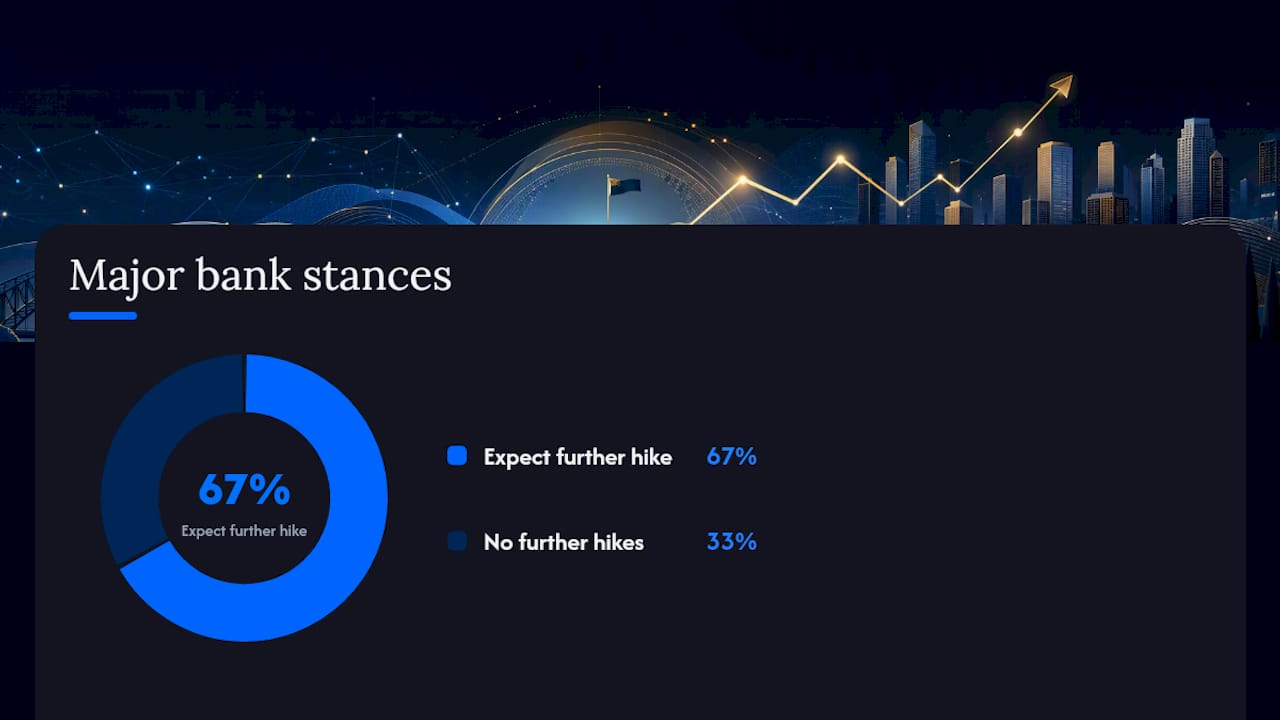
- CommBank revised its position in August 2026 to expect a 0.25 percentage point rise in November 2026, a call made after a stronger-than-expected July CPI print pushed the bank’s economists to abandon their earlier “hold for the rest of the year” position.
- NAB has pencilled in a possible move as early as September 2026, putting it ahead of CommBank’s timeline and reflecting a more hawkish read of underlying inflation pressure.
- Westpac has taken the most cautious stance among the majors, holding to a “no further hikes” call and arguing the Board has already done enough tightening to bring inflation back toward target without additional moves.
That spread between September, November, and “no more moves at all” isn’t a sign that anyone’s forecasting badly. It reflects genuine disagreement about how much weight to put on a single hot CPI print versus the broader trend. CommBank’s shift is instructive here: one stronger than expected inflation reading was enough to flip an entire bank forecast from “hold” to “hike incoming.”
That’s the pattern worth internalising: bank forecasts move fast after monthly data surprises, and they should. Treating any single bank’s call as gospel, rather than a snapshot that can flip within weeks, is how households end up making mortgage decisions based on stale information. The more useful habit is watching how forecasts change after each ABS release, not just what today’s consensus happens to say.
What to watch next: data, RBA meetings and market signals
Not every RBA meeting carries the same weight. Four meetings a year, aligned with the quarterly Statement on Monetary Policy, come with a full refresh of the Bank’s forecasts. The other meetings publish a decision and a statement, but no updated numbers, so markets lean heavily on the tone of the post-decision commentary at those sessions. The next scheduled decision lands on 29 September 2026 at 2:30 pm AEST, with a press conference following at 3:30 pm, and it’s a non-SMP meeting, meaning the real signal will come from the Governor’s language rather than fresh forecasts.
Between now and the next SMP release, four data points matter more than anything else:
- ABS monthly and quarterly CPI, including the trimmed mean measure that strips out volatile items. This is the primary series the RBA uses to judge whether inflation is genuinely cooling or just looking better on paper.
- The Wage Price Index, released quarterly by the ABS, which tells the Board whether wages growth is settling toward a sustainable pace or still running ahead of productivity.
- Employment and unemployment data, watched for signs the labour market is loosening naturally rather than through a sharp downturn.
- Global oil prices, because a sustained spike flows through to petrol and transport costs quickly, and the SMP baseline explicitly assumes stability there.
A hot CPI print, paired with wages still accelerating, is the combination most likely to tip the Board toward one more hike. A soft CPI print alongside rising unemployment would do the opposite, and could bring cut talk forward from “sometime in 2027” to “maybe late 2026.” Anything in between, which is the most probable outcome, likely means another hold and a wait for the next SMP.
Pro Tip: Don’t wait for a single RBA meeting to update your financial plan. Re run your repayment and borrowing scenarios after every major ABS CPI release, since that’s the data point most likely to move bank forecasts between now and the next Statement on Monetary Policy.
What the 2026 outlook means for borrowers and property investors
A hold at 4.35% keeps things tight but stable. Another 25 or 50 basis point move changes the maths on a mortgage in ways that are easy to underestimate if you haven’t run the numbers recently.
Take a representative example used by mortgage advisers: a $600,000 loan with 25 years remaining. Industry estimates suggest a 0.25 percentage point rise adds roughly $90 to $100 a month in repayments on that loan. Stack two such rises, the kind of move implied if the Board hikes once more and conditions stay tight into 2027, and you’re looking at somewhere near $180 to $200 extra a month, or roughly $2,200 a year, on that same loan. That’s before accounting for any change in living costs elsewhere.
The maths behind that squeeze: on a $600,000 loan with 25 years remaining, each 25 basis point increase adds an estimated $90 to $100 in monthly repayments, according to adviser calculations. Two such moves compound to close to $200 a month in additional cost according to industry estimates
Borrowing power takes a hit too, often a bigger one than repayment increases alone suggest. Lenders apply serviceability buffers, typically adding a margin on top of the actual rate when assessing whether you can afford a loan, and they weigh your existing debt-to-income ratio heavily. When the cash rate sits higher for longer, that buffer bites harder, and the maximum loan a bank will approve shrinks even if your income hasn’t changed. Anyone shopping for a new loan or planning an upgrade should factor in that debt-to-income limits can quietly cap ambitions well before the rate itself becomes the binding constraint.
For property investors, the transmission mechanism runs through demand. A “somewhat restrictive” cash rate setting is designed to cool borrowing and spending, and housing credit growth is one of the more visible channels through which that plays out. Slower credit growth generally means less competitive bidding at auction and softer price growth, particularly in markets where buyers are more leveraged. That dynamic shows up unevenly across the country, and readers weighing city-specific conditions can find useful colour in local market commentary, including Brisbane-focused analysis that digs into whether particular capital city markets are approaching a turning point.
None of this is abstract if you’re deciding between buying now, rentvesting, or waiting. Running a 0.25% and a 0.50% rate scenario against your own numbers, rather than relying on a generic example, is the difference between a plan that survives a rate surprise and one that doesn’t. Free quarterly property valuations and a 15 year scenario modeller let you stress test exactly these kinds of moves against your own borrowing capacity and goals, without guessing at national averages.
What to check before you lock in a plan:
- Your current loan’s rate type (fixed, variable, or split) and when any fixed term expires.
- Your lender’s serviceability buffer and how it’s calculated on your specific loan product.
- Whether your debt-to-income ratio has room to absorb a further rate rise without breaching lender limits.
- How a slower credit growth environment might affect the specific suburb or property type you’re targeting.
Practical next steps for households and advisers
Waiting for certainty from the RBA before acting is a losing strategy, because certainty won’t arrive until well after the decisions that matter have already been made. The households in the strongest position right now are the ones treating the next few months as a planning window, not a waiting room.
Immediate actions worth taking:
- Stress test your repayments against both a hold scenario and a further 25 to 50 basis point rise, using your actual loan balance and term rather than a generic example.
- Consider fixing part of your loan if you want repayment certainty over the next 12 to 24 months, weighing that against the flexibility a variable rate or an offset arrangement gives you.
- Review your cash buffer. Three to six months of repayments in an accessible account is the usual benchmark, and it matters more when the Board has flagged its stance as restrictive rather than neutral.
- Talk to a broker or adviser about how your current debt-to-income position would hold up if lenders tighten serviceability buffers further.
- Update your scenario models after every CPI release, not just after RBA meetings, since bank forecasts move on monthly data more often than they move on Board decisions alone.
On the budgeting side, prioritise paying down higher cost debt, like credit cards or personal loans, before extra mortgage repayments, since the rate differential usually makes that the more efficient use of spare cash. A structured budgeting approach built around 2026’s rate environment specifically, rather than a generic budget template, tends to hold up better when conditions shift.
For investors, the calculus is about horizon and yield expectations rather than repayments alone. If your investment thesis relies on strong near-term capital growth, a restrictive rate setting is a headwind worth pricing in now. Understanding why property cycles move the way they do helps put the current tightening phase into context rather than treating it as a permanent state.
Pro Tip: Don’t anchor your decisions to one bank’s forecast or one RBA meeting outcome. Re run your numbers every time the ABS releases fresh CPI or wages data, because that’s the rhythm the market itself trades on, and it will keep you ahead of headlines rather than reacting to them.
Where to verify the numbers yourself
Every figure in this outlook traces back to a primary source, and it’s worth bookmarking them rather than relying on secondhand summaries. The RBA’s cash rate target page updates immediately after every Board decision. The Statement on Monetary Policy publishes quarterly, with the fullest set of official forecasts and conditioning assumptions. Governor and Assistant Governor speeches, like the August 2026 address on the restrictive policy stance, often preview shifts in thinking before they show up in formal statements.
For inflation data itself, the ABS Consumer Price Index series is the authoritative source the RBA uses, and it’s released on a regular schedule you can track directly. On the bank forecasting side, CommBank’s economics commentary offers a useful window into how quickly professional forecasts shift after a single data surprise, which is a habit worth adopting for your own planning.
If you want to see how any of these scenarios play out against your own mortgage or investment plan, Wealthstacker’s free scenario modeller lets you test rate moves, borrowing power, and 15 year wealth projections using your own numbers rather than national averages.
This article is general information, not a substitute for advice from a qualified financial advisor. Consult a qualified financial professional about your own circumstances before acting on anything here.
Sources
- Cash rate target — Reserve Bank of Australia
- CBA economists change rates call to November rise after July inflation surprise — Commonwealth Bank
- Consumer Price Index, Australia — Australian Bureau of Statistics